Geosophia is nothing else than the knowledge of the qualities of the earth, and the knowledge of these qualities by those living amongst them.

Such was the synopsis of Johannes Christophorus Homann’s Dissertation entitled Medicinae Cum Geosophia Nexu, quam auspice deo propotio.

Written in Latin around 1720-1724, the title of this work translates to “The medical-geosophia connection, as proposed under the auspices of God”.

Homann is the first to define in writing a popular belief held for the time, which states that theosophy, geography, anthropology, health and medicine are all embraced by a single field known as Geosophia or geosophy.  The roots of this term are ‘Geo’ for ‘earth’, and ‘sophia’ for ‘knowing’ and ‘wisdom’.

.

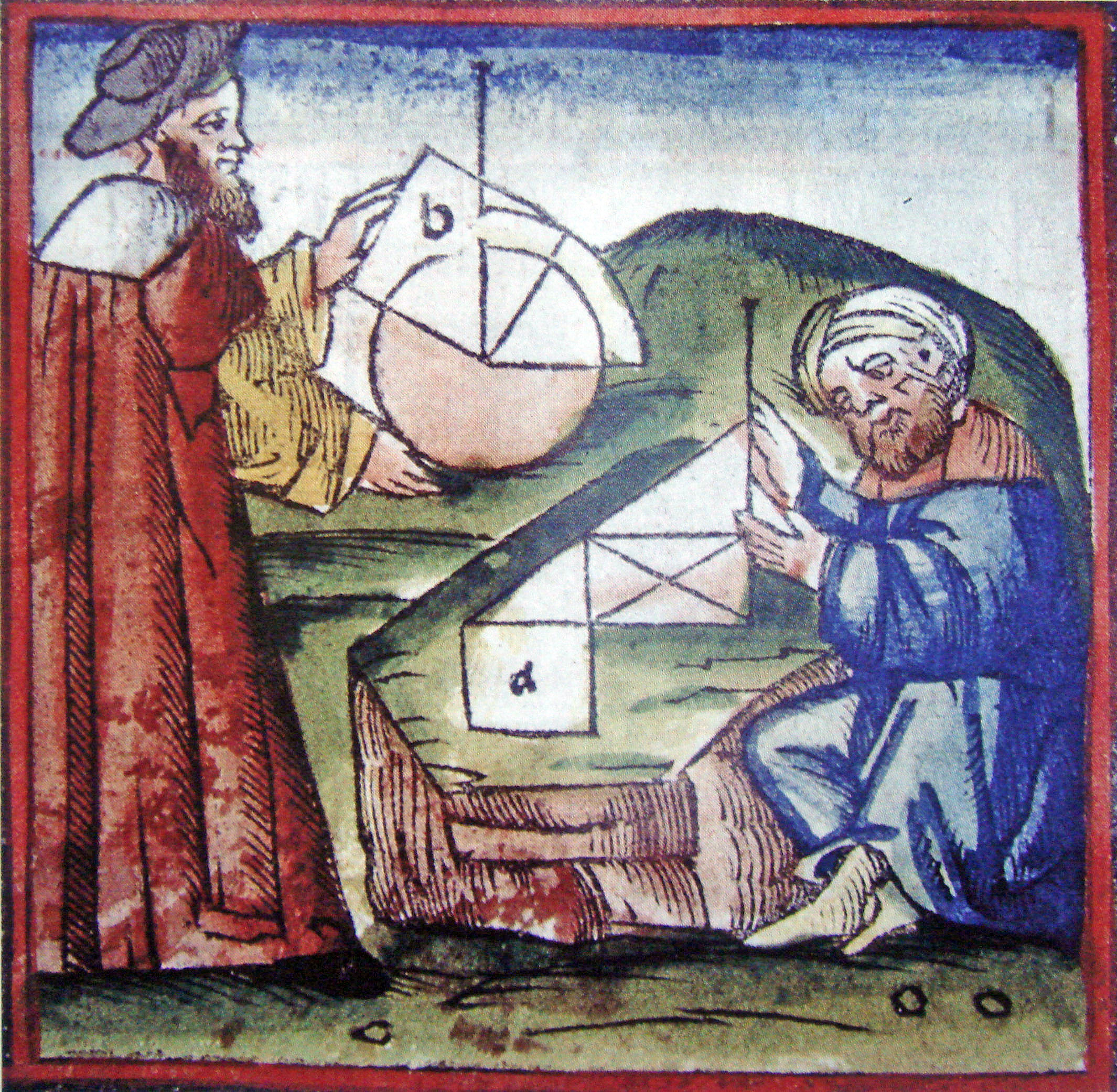
This belief was very different from the much older, more traditional teachings of geomancy.  Geomancy essentially was a practice that required the art of predicting specific attributes for a given place or region.  Whereas geosophy involved the practice of observing and then explaining natural features and events based on previous knowledge and experience, geomancy involved the production of lines, points, circles, squares and other forms on a piece of paper or writing surface which are then interpreted and developed into some sort of message with special meaning.  Geosophy was linked to the art of map making, in particular precision map making skills which made use of geometry and mathematics and at times looked at the various unique forms of nature as expressions of divine art.  Geomancy was the search for meaning of the shapes and forms evolved from various clues provided, using mathematics as well, but in a more metaphysical way and often with sacred geometry  underlying its philosophy and ideology.  Geosophy usually adhered to a belief in the classical Christian God.  Geomancy relied more upon the natural God, or G-d, or spirit, or Creator, or Universal Energy.

.

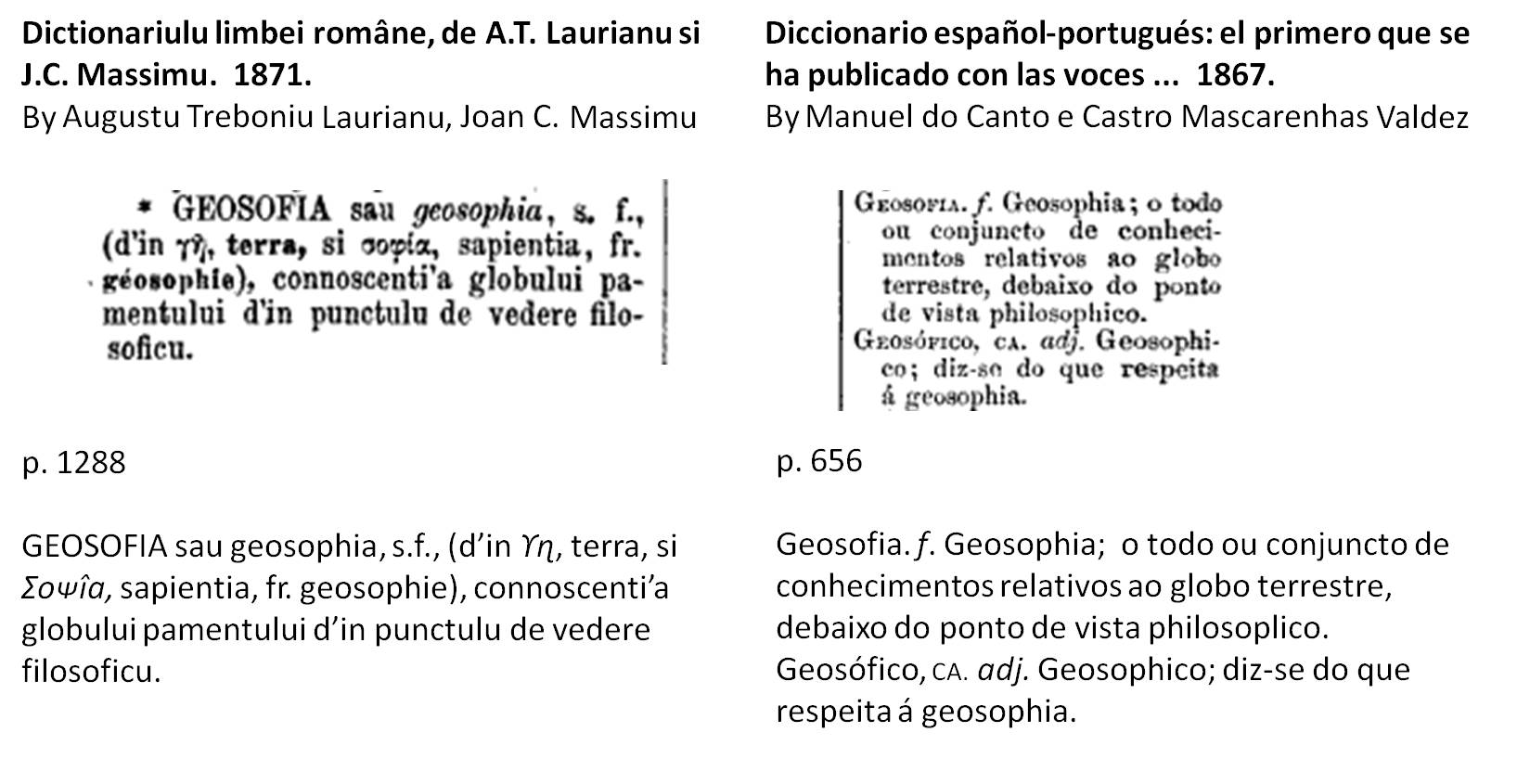
Definitions of Geosophia, a term primarily of German use and application, in two European Foreign Language Dictionaries.

During its earliest years of use, from about 1729 to 1785, the term geosophy was considered synonymous with theosophy, even though the latter makes a direct reference to theos or God, whereas the former only refers to Earth.  Such a use of the term ‘geosophy’ during this time appeased both religious and non-religious groups, and in New York, or more accurately stated, New Netherlands history, it satisfied the pantheistic nature of the religious and non-religious settlers who believed in this natural philosophy tradition.  The first settlers of this region tended to believe in natural philosophy much the same way–the belief that God was, is and shall always be a part of nature.

.

The most religiously minded settlers devoted to natural theology considered nature to be a form of Divine Art.  Early New York female botanist Jane Colden, for example, demonstrated her attachment to the natural signs for plants and their uses, features important to her due to her work in plant identification (see Jane’s Plant Numerology).  In a review of the plants discussed by the Jesuit missionaries trying to convert America Indians in Canada, we find writings that demonstrate a fascination with plants and plant parts that bore the signs of trinity–for example a leaf with three lobes, and a plant bearing three kinds of leaves, both considered defining features for the sassafras tree.

Augustine Hermann (1605-1686), Counselor and metaphysician for Elizabeth Philips

The late 17th and early 18th centuries also defined a period of time when mysticism was honored, and the most important mystic of all locally, Jakob Boehme, had developed a popular movement along the Hudson River, involving members of the Filipse family.    The most traditional Boehmites supported his teachings of alchemy as a spiritual philosophy, with the mercury, sulphur and earth of Paracelsus considered representative of the various physical, spiritual and soul related parts of the body.     Another set of followers for this New Paracelsian movement were the Helmontians, Dutch individuals who took to the metaphysical claims in medicine made by the famous Dutch chemist Van Helmont, the famous professor from a Dutch University.

.

John Dee (1527-1608/9, source: wikipedia)

But there was also the philosophy of the British playing important roles in these social belief changes.  Christian Alchemist John Dee was an English Alchemist who was spreading his version of New Paracelsian philosophy to religious leader John Winthrop, Jr. of Connecticut.  From here it probably spread into the New York region by making its way westward into lower New York, primarily influencing areas east of the Hudson River and well distanced from the more traditionally motivated City of New York located to the south.  This manner of spread for new philosophies would continue to be seen in the years ahead, for example the next new form of medical electricity faith which took the route from Connecticut to New York in 1797.

.

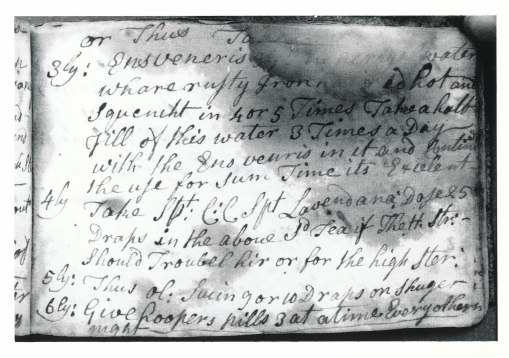
In addition to Boehme, Van Helmont and Dee, there was the philosophy of a Bermudian scholar who removed to Harvard around 1649 to study Christian Alchemy.  George Starkey’s philosophy came a result of his education in the traditional writings on alchemy accompanied by his own personal communications with God, as he attempted to create the perfect philosopher’s stone, or as he called it “ens veneris”.  He managed to succeed in this venture by 1651, and passed on his discoveries to the most important chemist for the time Robert Boyle, but never got the full support and recognition he had hoped for (perhaps because Starkey  claim to have received many of his ideas from God Himself, at least according to his personal notes that were reviewed and republished 10 years ago; this could have made Boyle feel a little uncertain about Starkey’s once he read these lines in Starkey’s diaries/lab books; nevertheless Boyle took this idea and produced a similar iron based version of ‘ens veneris‘ with it, the most popular outcome of this piece of history for which Starkey gets no credit for . . . c’est la vie/vitre).  So, like other New Paracelsian ways of thinking, his philosophy remained more a part of the local oral and handwritten history of the region, stored in manuscript form in various archives, not as part of any written and officially published history.

.

John Baptiste Van Helmont (1579-1644, source: wikipedia)

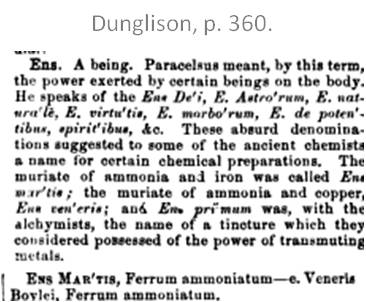
The Ens or Entia, power of being, was an important idea critical to how medicine was practiced during the 17th century.  It became very important to Homann’s philosophical interpretations of the world as a cartographer due to his belief that plants grew in regions where they were needed–a traditional, very pastoral way of interpreting man’s relationship with the wilderness.

.

Friedrich Hoffman (1660-1742, source: wikipedia)

By the end of the 18th century, several scientists interested in these philosophical principles were also developing their own philosophies about health and disease.  One such writer was Friedrich Hoffman, a religious leader, chemist, mechanist, and new form of alchemist.   His associate and counterpart for the time was once again Van Helmont.  Together their preachings helped promote ideas about another form of the entia of plants–their essence or smell, or essential oil.  Considered the fifth element of plants by neo-Paracelsians, its values were considered alongside those for earth, air, fir and water when it came to healing.    As noted in my research on Dr. Cornelius Osborn, ca. 1745-1783 medical practitioner, both Hoffman and Van Helmont were popular to early American medical practitioners who wrote, taught and practiced their beliefs along the Hudson River Valley of New York during the mid to late 1700s.

.

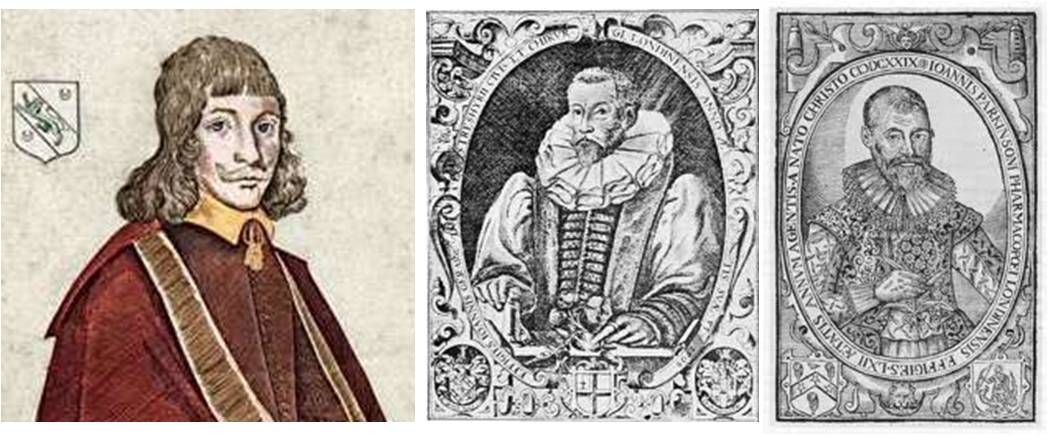
Herbalists Nicolas Culpeper (1616-1654), John Gerarde (1545-1611), and John Parkinson (1567-1650)

Some of the most important plant medicine philosophers for the New World and European medicine in general included Christian Astrologer and herbalist Nicolas Culpeper, along with John Gerard and John Parkinson.   An herbal by Matthioli also existed in one of the local Dutch settlers’ libraries of the Hudson Valley.  It was through the work of Culpeper however that many of these latin writings became readable by those only trained in English.  Likewise for author and famed chemist Robert James, an apothecarian favored by Royalty whose translations of the famous Latin books by Sydenham made it possible for early American physicians to make sense of the native plants blooming all around them.

Still, it was Johannes Christophor Homann’s study of the philosophy and materialistic presentation of geosophy that served as one of the most important primers to assisting in the evolution of a Hudson Valley medical philosophy, one that was not only based on the more physiographically based traditions of disease theory and healing practices,but also upon the metaphysical components of nature, and the religious qualities of natures symbols, God’s Signs.  These teachings of the earlier natural philosophers were supported worldwide by the influences the Homann family had on the world as cartographers of place and people.   But it was J.C. Homann’s writings that had the most important influences of all-with this dissertation he enabled nature and the natural forms of God to become an important part of both European and early American medicine.

Johann C. Homann was not a mystic like Jakob Boehme.  His philosophy of health and disease was more focused on the physical world, but he recognized the role of God in creating these natural gifts.   Homann’s philosophy therefore was not at all agnostic or atheistic, or completely Newtonian  and mechanical in nature.  Instead, it had a metaphysical aspect that taught us how God through Nature played a role in defining both our health, our diseases, and our potential for discovering much-needed medicines.  To many colonial physicians, it worked well alongside the writings and teachings of religious leader and physician Friedrich Hoffmann.

Like many believers in God, nature was God’s most important gift to us.  Due to the Homann family history, J.C. Homann was very familiar with the physical make up of the world, and so once he took control of the family business in cartography in 1703, he became very interested in exploring the relationship between place and medicine.  He accomplished this successfully with his dissertation, for which he received a medical degree from the university in Halles along with some much-needed support from the church.  This writing also makes reference to a number of individuals who greatly influenced him, their metaphysical philosophies most important to understanding the underlying wisdom of the book and how the field of medical geography came to be as a by-product of J.C. Homann’s Geosophia.

During his schooling, one of Homann’s mentors and teachers, Rudolph Wilhelm Crausius, who wrote the following in an oration to his students, a few years before Homann received his degree in the study of medicine from the university in Halles:

Hippocrates Medicinae parens optimus in eo, qui fe Aesculapii саstris devovit, requirit naturam, locum studis aptum, industriam, tempus, doctrinam, institutionem a puero.

Physician Hippocrates, the father of the best [physicians], who devoted himself to the camp of Aesculapius, requires that nature be a place of study of industry (work), time, doctrines (ways or laws), and the manner of living for the new and the young.

.

Homann had limited influence for years to come in early American history.  His influences during the last Colonial years were evident, although never mentioned or referred to as such.  The beliefs were their, but their source soon forgotten.

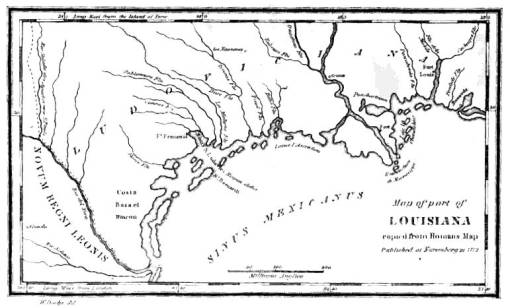
We also don’t see any direct or indirect clues to The Homann family’s influences on United States in general, minus its medical history, until 1815, when a mid-18th century Homann’s map of Mexico played an important role in defining our rights to own and possess the former New France territory of Louisiana.

From William Darby’s 1817 book A Geographical Description of the State of Louisiana

In the years and decades leading up to this moment in American history, Homann’s work was generally used to describe the various continents and countries of the world, producing several Atlases along the way.  The influences of Johanne Christopher’s dissertation on the study of medicine, geography, health and disease would not be seen or felt for another 75 years.  J.C. Homann’s geosophy teachings remained a topic of religious and spiritualism studies, rather than a study of science and nature.  [Note: a brief mention of the “Geosoph” appears on p. 237 of an 1780s writing published in 1790 as part of Neuer Atlas . . . .  1790 and is mentioned in Allgemeine deutsche Bibliothek, Volume 106, edited by Friedrich Nicolai, page 105.  No links as of yet are made for this use of the term, but probably existed as “fuel for the fire” in the United States medical geography writings just a few years later.]

Geosophie ~ Theosophie

The following entries in two ca. 1900 German lexicons provide us with insight into the cultural limitations that kept J.C. Homann’s term from becoming commonplace.

Geosophie od[er] Theosophie ᵻ: Molenaar, H., Flugschriften 6.

From Vollständiges Bücher-Lexicon by Christian Gottlob Kayser, Alexander Bliedener, Ernest Amandus Zuchold, Gustav Wilhelm Wuttig, Richardt Haupt, Albert Dressel, Oskar Wetzel, Heinrich Dullo, Heinrich Conrad, August Hilbert, Richard Schmidt, Alfred Dultz.  1908.  p. 141.

Geosophie s. Theosophie. 

From Karl Georgs Schlagwort-katalog: Verzeichnis der im deutschen Buchhandel  erschienenen Bucher und Landkarten in sachlicher Anordung. V. Band 1903-1907.  1. Abteilung.  A-K.  p. 635.

.

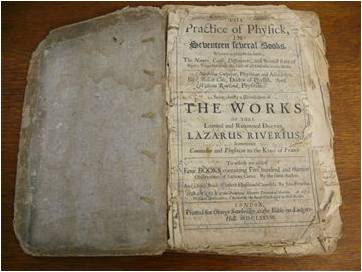
Throughout the remaining 18th century, Homann’s influences were seen with the writings on the healthiness of different parts of the world.  The health of New York and the Hudson Valley as detailed by Cadwallader Colden, the metaphysical take on mechanisms responsible for how medications worked on ailing bodies, the notion that air flow patterns and directions, weather, climate and topography could help define the health of a given region, were all based upon beliefs held by J.C. Homann as well as well as the traditional writings they referred to by Riverius.

Between 1730 and 1750, the writings of Riverius, Hoffman and Homann played very prominent roles in how medicine was being practiced and how the causes for disease were redefined.  With the onset of the Revolutionary War, the exchange of similar knowledge occurred internationally as foreign physicians came to support the side of the Patriots.  This solidified the many teachings that related disease to the endemic and epidemic forms of disease taught by Riverius, and the roles of nature and natural philosophy in disease taught by Hoffman.  By 1796, this allowed the practice and study of medical geography to be developed by New York state physicians, a description of which appears in the very first medical journal published in New York City–Medical Repository.

Along with the works of Hoffman, Riverius and Hippocrates, Homann’s work turned medicine into an extension of the natural sciences (or natural history as they called it then).   With his Dissertation, Medicinae Cum Geosophia Nexu, Homann provides us with the term and  definition for the Geosophen, or Geosophers, and Medicinae Geographica, or Geographic Medicine.  The subsequent spread of this philosophy took several distinct routes during the late 19th century.  As a result, Homann helped to develop or greatly influence several major fields of study, namely:

  • phytomedical geography, and research focused on the importance of local herbal medicines for treating local diseases,
  • anthropology, and its subspecialty medical anthropology–a study of disease and culture
  • medical geography, medical climatology, disease ecology, and the value of disease mapping, and
  • modern geosophy, or the study of sacred places.

Today we can state these influences to be mostly related to the knowledge of the following, promoted as a part of Homann’s dissertation writings:

  • the absence or presence of medicinal plants befitting a region
  • the absence or presence of specific cultural and anthropological ways of being and behaving
  • the absence or presence of specific diseases characteristic of the region and therefore defined as being epidemic or endemic to it
  • the existence and cultural definition of special places, human values placed upon these objects which are defined by their location, form and the occurrence of specific, related human and/or natural events

In a more modern sense, Homann’s term Geosophy was rediscovered or perhaps even reinvented from scratch during the 194os (see wikipedia entry on this term.)  His dissertation on geographical medicine however did have an impact on common knowledge, and therefore over the years has led to the development of three of the most important specialities today in medical geography–geoepidemiology, disease ecology, and spatial epidemiology.  Each of these fields of study benefitted from the knowledge base that Homann’s maps produced for geographers and physicians and the geosophical essay Johannes Christopher produced as a result of his own enlightenment process during the 18th century.

.

.

Additions to this site over the last months include two new maps on medical or disease geography

My review of the history of disease mapping and epidemiology is focusing much more on the yellow fever.  This is because yellow fever set the stage for the large-scale production of disease maps seen by the mid-18o0s for global epidemic disease patterns like Asiatic cholera.  Aside from Valentine Seaman’s map of this disease–the first of its kind and already reviewed at this site–are two new examples of how the early yellow fever epidemics were first interpreted by medical geographers (but with no maps produced).  These include:

  • 1799 – Samuel Anderson and the Mystery of Yellow Fever in Curaçao and On Board.
  • 1806 – The Next War – Yellow Fever in Upstate New York and Matthew Brown.  This page in particular addresses the geographic definition of disease issue developing in the United States.  This philosophy of assigned place names for particular diseases was less than 10 years old, and was disputed abroad and even by other physicians located in other parts of the U.S.  The politics underlying to identity of a disease was that place-name also indicated place of cause–either locally or by means of import by way of land and water travel.  Each had its repercussions economically, and in the case of New York, certain families had their reputations at stake due to these arguments.  [See also the long four part tale about John W. Watkins and the tale of “Lake Fever“, not Yellow Fever, a disease common to the region in Western New York he just purchased, with plans for settlement–Watkins Glen or “Salubria“.]

Between 1800 and 1850, the medicine of livestock or what later became veterinary science was developed.  Some of the earliest examples of this (with much more to follow) are provided as:

Synopses on the two sets of disease mapping projects I have been engaged in are provided as distinct pages.  These are for comparing maps that demonstrate similar spatial features or represent similar goals and techniques used for disease mapping,  They are:

.

Also, for those “addicted” to the use of GIS for mapping population health, more of my research on population health analysis has been posted as well.  These appear as icons posted on various pages summarizing my work or discussing the applications of GIS to modern epidemiological research.  Approximately 200 examples of population health analysis locally and regionally have been provided (approximately one fifth of the results of this project), but are not being promoted at this time.   You can see examples of these at

Ï   Α   Τ   Ρ   Ω

Based on 20 years of experience living in the Pacific Northwest as a student, university lecturer, and population health analyst, I am also pulling these “video maps” together to present a single public health topic or theme, for example a Regional Population Health Analysis of the Pacific Northwest.  This project (a work in process related to my National Population Health Grid project) can be reviewed at

REGIONS & HEALTH – the Pacific Northwest as an Example

This represents cutting edge use of GIS and some of my analytic techniques.


ó ô ö ò.

hint:  symbols are links to map videos

Medical Geography and the History and Anthropology of Medicine and Public Health

This site is focused on information, information sources and discoveries made over the years about the history of medical geography. The goal is to improve our understanding of this field, its philosophy and its traditions, and then use this information to develop new applications of GIS applicable to the fields of public health, epidemiology and medicine.

My most recent additions to this site (during the past 6 months) include a number of new discoveries about Hudson Valley medical history. I view the Hudson Valley as the heart of the new medical philosophy and thinking that surfaced between the 1700s and the initiation of the Civil War. Most people envision Philadelphia and Boston as the most important cities related to American medical history and any American related discoveries prior to 1810. Whereas Philadelphia has Benjamin Rush’s accomplishments to brag about, and Boston Dr. John Warren of Harvard to boast, New York had its senator and physician Dr. Samuel Mitchell to pat on the back.

Samuel Latham Mitchell (1764-1831)

Dr. Samuel Mitchell was the “Renaissance Man” of his time due to his training in medicine, the law, politics, philosophy, and all of the natural sciences as a student of the University of Edinburgh. His accomplishments, theories and writings resulted in the transformation of medicine into a study of natural science, beginning with his first year as a professor in 1792 at Columbia College in New York. His numerous intellectual moves and scientific speculations typically earned him a lot of support from the locals, thereby drawing much of the professional and political attention away from other ivy league schools and competitors such as Yale, Harvard, the medical school in Philadelphia.

Mitchell made New York the focus of his work, serving as editor for the journal of its time–Medical Repository. For decades to come, he was considered an expert in numerous fields, including evolutionism, paleontology, geology, chemistry, psychology, meteorology, medical geography, medical topography, astronomy, engineering, and natural philosophy. Whereas Benjamin Rush and others focused mostly on just people and health, Mitchell and his strong New York following focused on the environment and it relationship to people and health.

Due to Mitchell’s work, regional interpretations of disease and health came to be were popular. He and his closest supporters began strongly promoting a new science which he called medical geography. This geographical focus on disease and people was lost once the bacterial theory was born and microbiology, physiology, chemistry, and epidemiology became the focus of much of medicine during the later parts of the 19th century. Until the late 1880s however, geography was as much a part of medicine as the studies of anatomy, physiology or pathology.

All of this changed when the world globe and its various maps were replaced by the microscope and the focus in the bacterium–the microcosm instead of the macrocosm. This paradigm shift did what it could for the best of medicine. But in the end, we alaways need to go back to the origins of many of the philosophies out there about health and disease. For this reason, some portions of this site are devoted to medical geography as a physical science and population health study, others focus on sociocultural aspects of medicine and disease in the Hudson valley, using these findings to help explain how and why new healing faiths are born.

Regarding the important role the Hudson Valley played in United States medical history, until now I have reviewed mostly those physicians noted in the past previously reviewed by other important medical historians and biographers such as Helen Wilkinson Reynolds and Guy Carleton Bailey. My more recent additions focus on individuals not really discovered by previous medical historians, or at least well reviewed by them. These individual made very important contributions to rapidly growing field of medicine from 1785 on. Their impacts on the profession became both regional and national, as this nation itself expanded and its new settlers carried with them this unique knowledge born in the Valley. As a result, a lot of my biographical reviews from this point on are about individuals whom to date have never fully researched or studied.

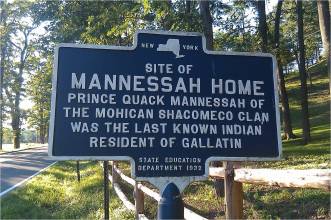
The first such individual to note is Prince Quack Mannessah. His parents were a converted Mahican father and Algonkin mother who resided near the old Moravian missions site just south of Pine Plains, NY. His grandparents were part of the first Native American clan to ever be completely converted to Christianity, a result of the missionary settlement established around 1740, a decade before they were forced to remove to the Midwest (soon after which, all were killed).

By living according to Christian Indian beliefs, Mannessah resided on land just north of Pine Plains, along with a number of African American servants working for a local farmer who owned a large piece of land. Mannessah took on his family’s heritage and became one of the first “Indian doctors” in this country beginning around 1780 or 1790. Along with others of his heritage residing elsewhere in the United States, his Indian medical philosophy and practice increased in popularity over the years and by 1800 led to the initiation of a major national movement what was called “Indian root doctoring”, a movement which which he continued for the next 60 years and a movement revived and still popular following the Civil War.

Whereas many of the Indian doctors written about practiced a Europeanized form of pop culture medicine referred to as Indian root doctoring, it is only the first practitioners like Mannessah who truly lived and practiced according to their traditions. This opportunity for me to capture his life story is a rarity in United States and New York medical history. It provides us with information that fills an important gap that exists in American medical history and the influences of Native American culture and philosophy on United States medicine.

A map of Salubria or Watkins Glen from about 1778. The building structures are Iroquois Long Houses.

Next there is valetudinarian John Watkins, Esq. He was not a physician at all, but rather a lawyer (“Esquire” who married into the Livingston family–another family of “Esquires”) and as a result came to promote the value of land and the ability to adapt to your living environment as the way to assure good health and longevity. Like his in-law relative Chancellor Robert Livingston, John Watkins was a speculator of sorts who developed a partnership with Royal Flint, and then obtained the rights to establish settlements or “colonies” on a large tract of land in western New York. His company of investors, all from Kingston, NY, promoted this region as part of the great westward expansion for the US during the late 1790s. The most impressive piece of this land and its history is Watkin’s Glen.

A part of Watkins Glen

John Watkins used his knowledge and his family name to promote his own philosophy about a fever unique to his new born hamlet of Salubrai. He termed this disease Lake Fever. Lake Fever was possibly an early arrival of the yellow fever into the most inner parts of the North American continent. The ways in which Watkins interpreted life in the wilderness, the means to stay healthy by residing in such regions, and the way to live as a farmer and stewart in this part of the Western States, all helped him form his view of the most proper way to survive in this new environment. Therefore, his writing provides us with important insights in the new medical topography movement being established in American medical history.

Other important pages to point out at this site are the various disease maps I have added as a part of my ongoing review of the history of disease mapping. I have now reviewed most of the most important disease maps ever produced in the history of the medical field called medical geography. This time I focused on the history of the first ever map published in this country on Yellow Fever and the many maps that followed decades later which focused on Asiatic cholera.

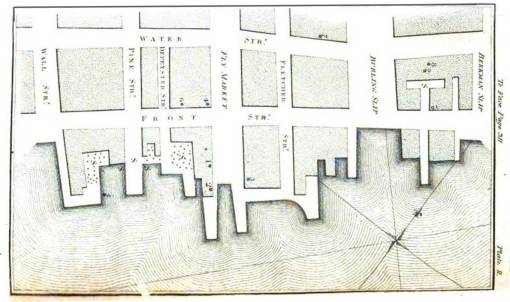
The second of Valentine Seaman’s Yellow Fever map, overlooking the east river at the end of Wall Street

My coverage of these maps used to identify the causes for disease begins with what is possibly the first such map ever published, that of New York/New Jersey physician Valentine Seaman’s map on Yellow Fever. Doctor Seaman mapped the progress of this disease at the wharfs in lower Manhattan. This map is presented and then analyzed to provide us with insight into the logic of his interpretation of disease. Unlike other articles about this map, it ends up Dr. Seaman’s logic was not at all in error. Neither Seaman nor others like the famous Benjamin Rush were at all correct with their deductions about the cause for yellow fever. The notion that it was either locally induced or brought from afar as a form of contagion were both very much popular. The correct cause for yellow fever and lake fever wouldn’t be understood for almost a century. Meanwhile, one of the most common arguments in writing appearing in the popular and medical press focused on this important public health issue. Philadelphia epidemiologist Benjamin Rush’s explanation for this disease was that it was due to putrid coffee beans being imported into this county. Seaman claimed the same but felt it had much to do with the smell of the decaying debris covering the mudy ground exposed around the docks during low tides. Only a ship surgeon would come close to discovering the true cause for this disease (also covered in this blog site), a claim which unfortunately no one else in the medical field ever paid much attention to.

I also reviewed the extensive work on malignant or Asiatic cholera performed by John C. Peters. Once a strong homeopathy advocate and editor for this country’s primary journal for this field, American Journal of Homoeopathy, Peters began his career as a physician as an MD also practicing homeopathy around 1837/1845. After 15 years of practice, Peters suddenly changed his mind about the homeopathic profession,and in 1859/1860 he became a strong promoter of sanitarian or hygienic medicine. He was also a strong advocate of research in medical topography, medical climatology, and disease mapping. Later, along with several colleagues, a research team was formed by the US government that produced the most comprehensive and most successful series of maps ever made on the behavior of Asiatic cholera around the country as well as globally. Peters’ work was promoted and sponsored by his employer from 1860 onward, but the most influential reports were produced just before strong support for the bacterial theory for disease developed in the late 1880s. Their most famous writings with disease maps came about in 1883, the maps of which are presented here.

Accompanying this section on Peter’s work is another series cholera maps detailing the various ways the medical cartographers tried to illustrate their interpretation of this global epidemic, presented on various pages. Amongst these maps are examples of the some of first temporal series of disease maps ever produced.

Other maps in this section include:

  • Judson’s map of the Mississippi River and Valley, with dates of infection for each town depicting the temporal pattern used by this disease to infect the interior valley of the US
  • Alfred Stille’s summary of his findings, meant to parallel Peter’s work and produce a map of the same, but with some interesting differences noted
  • Contemporary medical geographer Gerald F. Pyle’s review of the history of Cholera and what it tells us about modeling disease patterns and predicting future disease spatial behaviors.

.

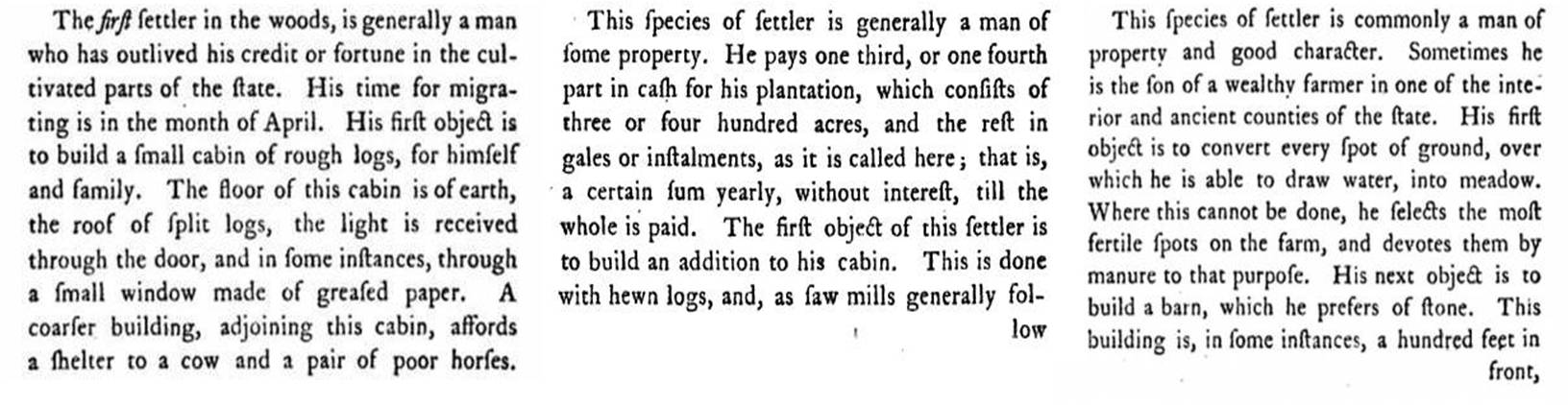
Benjamin Rush’s 1786 Three “Species of Settlers” – an early Sequent Occupancy Theory

Also, a series of very important articles related to the study of the history of medical geography are provided. . .

  • I begin this section with a page devoted to Benjamin Rush’s 1786 rendering of a philosophy that would soon be forgotten. This philosophy re-emerged a century later by another series of Midwestern medical geography writers, beginning with Derwent Whittlesey. These late 19th century geographers refered to this concept as sequent occupancy theory.
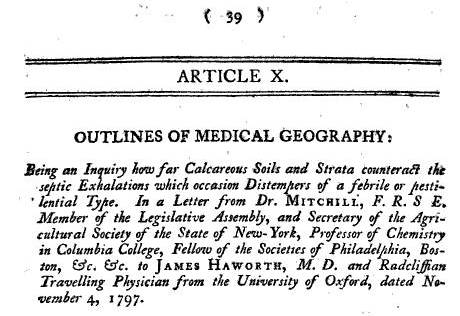
  • The second page entails an article that possibly has the first formal use of the term “medical geography” by an American author; it demonstrates how this philosophy came to be in the United States between 1795 and 1800. It was produced by congressman and physician extraordinaire, Dr. Samuel Mitchell, and dominated the medical profession for the next 50 years. Mitchell was the primary inventor, initiator and long time promoter of the many philosophies and future sciences linked to environmental medicine, health and disease. He created the septon (same root as sepsis)–referring to the smell and gas emitted from a rotting wound or biological mass. This invisible substance or particle he considered to be the cause for many otherwise inexplicable disease patterns–it was the “phlogiston” for this time in American medical history.

Another series of pages were produced that are devoted to regionalism and disease mapping. Each is written by an important person in the history of American medical geography. These include the following:

  • The very first renderings of medical geography articles reflecting regionalism for specific parts of this country as a whole (regions covered: Ohio-Virginia border, Marietta, Ohio, (with an early application of statistical epidemiology) and May’s Lick, Kentucky, by the famous Daniel Drake)
  • The very first renderings of New York medical geography demonstrating the various aspects of this philosophy shared by the writers, regardless of place (the regions covered this time through are mostly western New York ). These reports were requested by Governor Dewitt Clinton, in accordance with the related public health laws recently passed by the state.
  • Medical naturalist Jean Baptist Leblond’s Climate Zones and related disease patterns based on the ongoing yellow fever observations, published in 1806
  • An early description of the latitude theory for disease patterns
  • An example of the development of the alternative medical philosophies developing around this time, focusing on Dr. Charles Caldwell’s strong pro-medical topography/miasma-theory. His arguments represent a mixture of regular and “irregular” medical beliefs. Contagionists were at odds with the anti-contagionists during this time. Caldwell’s beliefs and work would later lead to the development of a number of other controversial alternative practices, such hydropathy and phrenology as parts of regular and irregular medicine, as well as the demise of the Transylvania Medical School opened down in the Bible State of Kentucky.

.

.

Finally, I have also initiated a section devoted to one of the stumbling blocks I encountered researching these projects–journals and books with articles that exclude or have poorly scanned maps or illustrations. This was due to actions taken by the documents imaging staff producing the electronic copies. To many librarians, the word is more important than the figure or illustration unfortunately. For medical cartography researchers like myself, this is very disappointing since the opposite is usually the case for our work.

The frustrations of map reading – incomplete maps at Google Books

It is important to note here that these scans would not have been possible were it not for the support of Google Books and the engagement of five major university libraries in this country. So this is not a major criticism; it is better to have something to read and study than nothing at all.

Due to Google Books, the equipment needed to scan these documents exists at several of the most important educational institutions in the U.S. However, the habit of producing unscanned, incompletely scanned, or poorly scanned maps because the inserts and fold-outs are of a different format perhaps needs to be re-evaluated, and a compromise needs to be made. It is frustrating to look up a book with the answer to your questions on a specific page or picture found in the book, only to learn that including that in the scan would be too troublesome. It’s like finding Vesalius’s book on anatomy, Richard Smellie’s book on child delivery, or a 16th century guide to chirurgical instruments, only to learn that all you can do is read the text page accompanying the figures, and not be able to review those figures because they are fold-outs. We know these images can be scanned due to their inclusion in many of the original historical references I have reviewed at Archives.org.

Phthisis=”consumption”, which usually referred to tuberculosis

Finally, I have to note that my concern is that the chances for obtaining copies of these maps in the future might forever be lost. Since medical geography maps are scarce, especially before 1880, and in danger of being removed from references illegally (a too common practice during the last few decades) due to the money they can bring on a black market, these historically important maps need to be digitized and their original sources identified and placed under better security (even historical societies and university rare book rooms have a habit of losing these valuable documents).

In terms of my other subjects, I have added significantly to my section on researching and charting population health, with numerous examples of how to perform more informative reviews of age-gender and disease, and a little on a new series of statistical formulas I developed for researching exceptionally large medical populations (>1 million, but for this review >100M). These methodologies are meant to be applied to a new form of research that can be performed regarding population health studies.

Recently I produced another way, another series of formulas for illustrating disease (using the traditional SAS formulas for DEM-like modeling). It is incredibly simple, at times too simple to seem real and true. It will probably take me about 2 more months to perfect, after which, I’ll re-write it for ArcGIS applications.

(Interested in this nationwide look at disease and place? see also another bit of new population health technology I created but not in use: http://youtu.be/HOburQ1ZiZA , http://youtu.be/ApyGwAJSsPc and http://youtu.be/IRPc-czaVWc)

To date, little to no time has been spent developing methods to review exceptionally large populations by any of the industries, universities or corporations that I have been involved with. The standard has been to sample a population and run your basic statistical techniques. These methodologies I consider to be less informative than I believe the statistical profiling of a population should be. Thus during the past decade or two, whenever possible, my methods have focused on small area analysis, on-the-fly GIS work in the field (see my west nile case studies for more on this), and large-scale studies of demography using 1-year age groups. I make use mostly of my own formulas and methodologies, which were developed by way of some GIS-RS work I was once engaged in. These define statistically significant differences at the 1-year age level for population stats (much like using edge detection formulas for b/w SLAR imagery work, or testing for aspect in a topographic map). The displays of my findings speak for themselves.

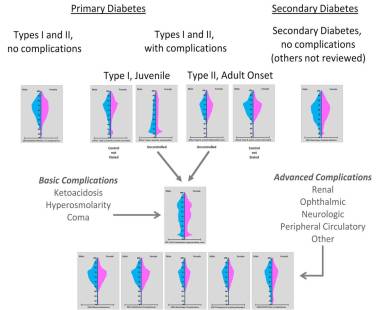
As an example of how this method is applied, imagine for a moment you have a population with a higher rates of something such as diabetes. The only problem is, all you know is the diabetes in high. You don’t know exactly which population it is higher in–the young, the old, the middle aged, the pre-retirement years workers, those from a specific ethnic group, so we look this up by reviewing distributions in more detail, and learn that it is women in their 30s that are making the population’s risk higher.

But the best example I believe related to this one unique ICD I reviewed in the past. My 1-year age-specific method of mapping counts and prevalence for ICD9 729.2* (the African culture practice of modifying the body in a specific way) revealed something never really published before. I discovered there were 4 age groups with exceptionally high prevalence rates for the Traditional African and now African American practice of infibulation and the other related “cosmetic” culturally defined surgical practices under this ICD (see my sociocultural syndromes page). This practice is considered necessary only due to cultural morées. It is not necessity to living in the United States. Yet two groups undergo this practice every year in this country–children under 6 years of age and adults 16-32 years of age (with 32 yo peak). The other two age peaks for this ICD are 47 yo and 80 yo. This is a very stable age relationship that has continued in this country for more than 10 years.

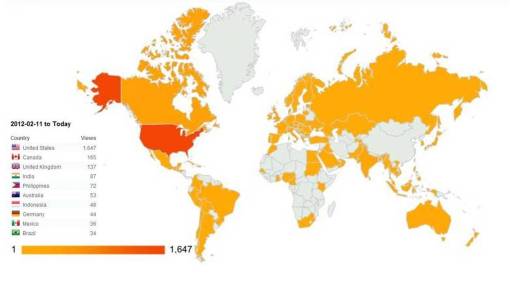
Thanks to WordPress, I can report that after just 18-20 months in the making, this site has surpassed the 50K mark for number of visitors, and is now averaging 175 hits per day, with the following distribution globally during the past 3o days.

By the way–so I don’t mislead anyone–the following is considered the first medical or disease map in the world press. (My work on this page is usually focused on the American press.)

See: Social Science & Medicine, vol. 50, issues 7 & 8, 1 April 2000, pp. 915-921.

Finke’s 1792 map of human diseases: the first World Disease Map?

Frank A. Barrett.

The large multiple legged area defined by the cartographer appears to demarcate safe routes of travel for troops, keeping them away from shorelines and large river edges–due to the miasma. . . high elevation areas–due to fatigue and apoplexy . . . and regions far into the continental interior, where diseases like scurvy, beri beri and goiter prevail. These paths travelled may also depict routes followed by specific diseases like measles, small pox, and many others caused by contagion.

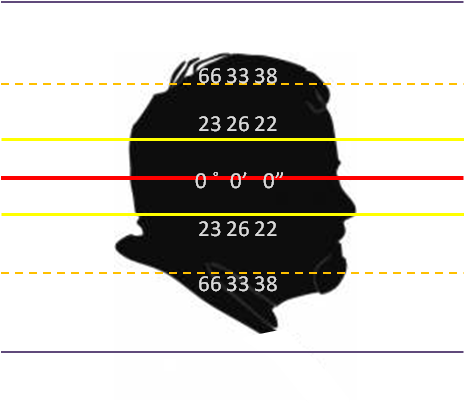
The New Era of Physiognomotracing = Cellphone Cam + Email + *.ppt + Dexterity

Medical Geography and the History and Anthropology of Medicine and Public Health  

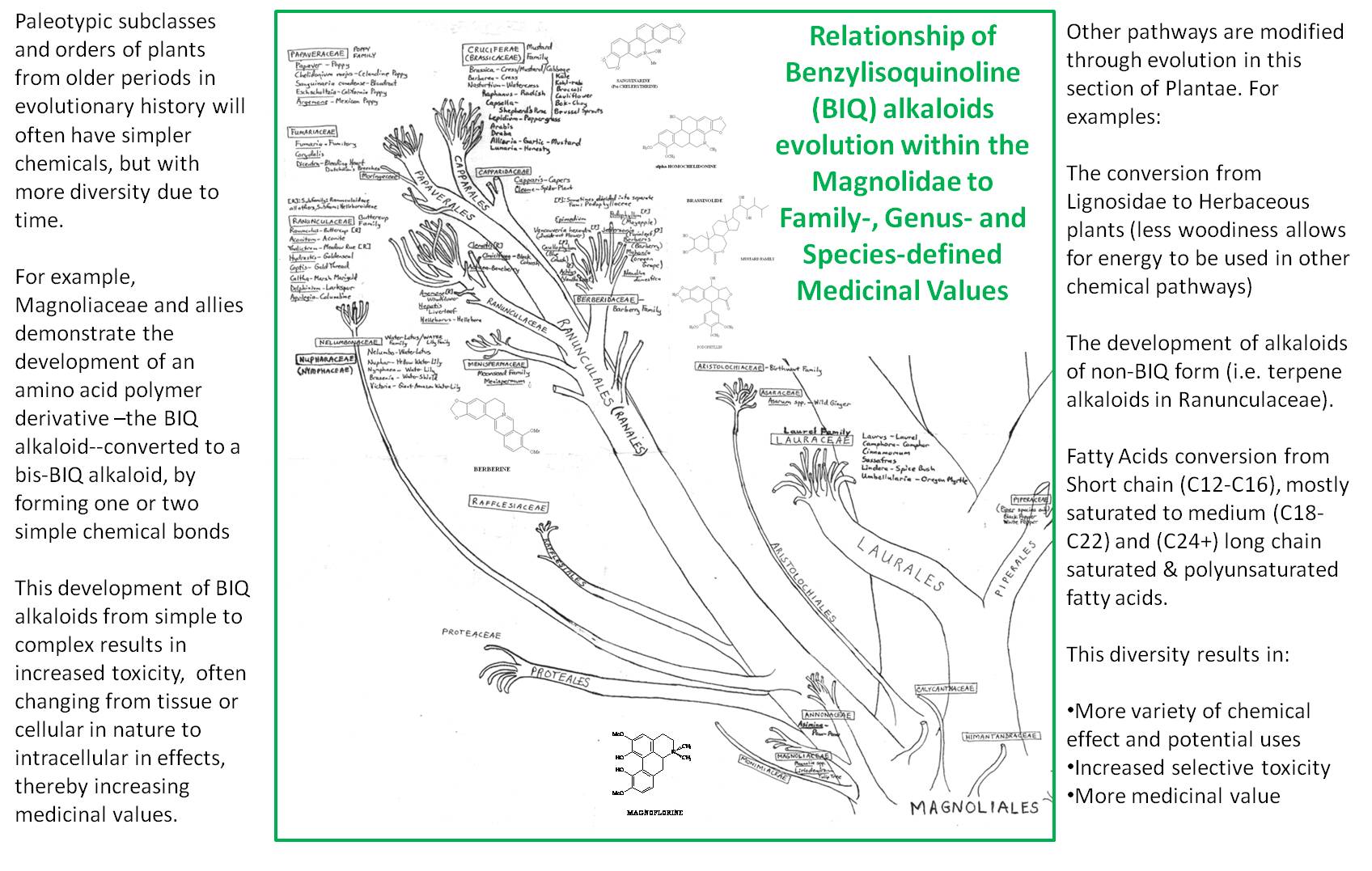
This site is focused on information, information sources and discoveries made over the years trying to promote the study of medical geography.  Medical history is my strength (other than a few science- and public health-related specialities readers will pick up on), so most of what I write are essays on discoveries made during the past 30 years researching the history of medicine, in particular New York and Hudson Valley medicine, but also Pacific Northwest medicine.  This information I developed as a part of my work as a specialist in plant chemistry, chemotaxonomy and natural products at Portland State University for nearly 20 years.  The chemical evolution chart I review on some of my pages was developed between 1987 and 1990.

This next series of biographies of local doctors reviewed includes a number of “doctors”, “physicians” or “healers” who have not been not covered by past writers of Hudson River Valley history.  One of these topics actually began the last time I posted on this page, soon after I initiated the biographies of Elisha Perkins of Connecticut, his followers along the Harlem River Valley and later those who promoted his healing faith along the Hudson River Valley in western Dutchess County. 

Until now, this view of Hudson Valley American Medical history has pretty much been tainted by past writers.  Stories like these have been interpreted as examples of how unlicensed, poorly trained practitioners out there are laying claims to their unique philosophies and ways of treating.  The fairly generic and culturally biased term attached to these kinds of practices is “quackery.”  But these practices are no more incorrect than the regular practice of medicine was during this period in Hudson valley history.   

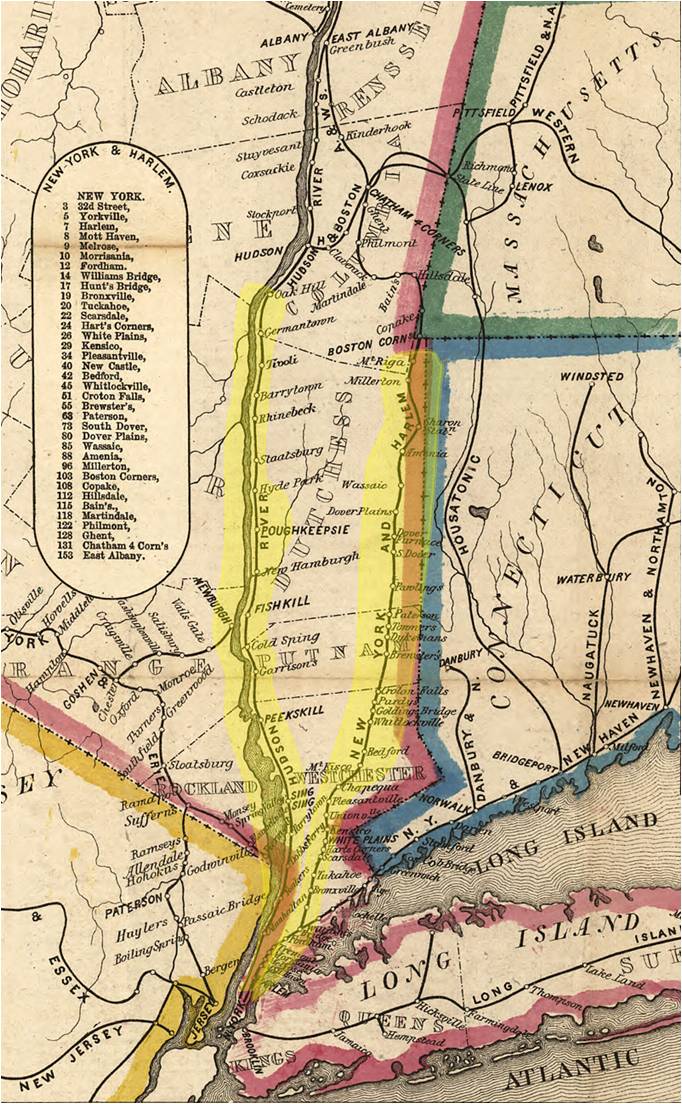
Hudson and Harlem Valleys and Railroad Lines into Dutchess County, 1858.  Perkins’ philosophy came to be prior to the development of any railroad or steamboat lines, back when all of the local roads led to New York City, Newburgh, Poughkeepsie, Troy and Albany.  The 1795-1810 Medical Electricity pop culture movement travelled from Connecticut to New York in a westerly direction, making its way to Troy and Poughkeepsie, but never developing much support in and around New York City.  This was due to the number of licensed and formally educated physicians practicing in this regional commercial center.  Between 1800 and 1850, medical philosophies were first spread by  sailing ships and stage coaches, and later by streamboats and finally trains.  Most of the professions during this time were spread by way of these two earlier commercial routes.  This meant that the two mountain ranges–Taconics and Berkshires–formed important cultural barriers.

The tale of Elisha Perkins and why he became so popular are reflections of the highly multicultural setting the Valley developed due to its Dutch heritage.  The philosophy helped set the stage for alternative philosophies like those practiced by Dr. Osborn (Bordenism, a 1760s vital force theory, covered elsewhere), Jewish Physician Isaac Marks, early Dutch promoters of Christian alchemical thinking (1649, Harvard student George Starkey, not yet covered), and the various Huguenot healers in the Valley who were natural philosophers and faith healers, and the unique believers in Christian Astrology and mysticism (one of whom in 1720 was called a “witch” according to Court records, partially covered).  These faiths were followed by the practices of local Quaker physician Shadrach Ricketson, his associate in the Friends Meeting House Jedediah Tallman, and Medical Electrician Caleb Child.  These events produce the history that set the stage for what would happen to the newest healers to come to the Valley for the remaining first half of the 19th century.  

The general impressions we are given for the past 3 or 4 decades is that there is this schism related to “medicine” versus “quackery”–the true or licensed, regular doctors, versus those who were more interested in nature, the body, mind and soul of medicine, and the healing processes accompanying these belief systems.  For this reason, we traditionally called regular doctors “licensed” and the other healers “quacks” in the worst of cases, be they licensed or not.  This is a social and culturally defined prejudice or biasness that even today many medical history writers express too freely and without any concerns for validity or personal opinions and subjectivity.  It is better to review past doctors for who and what they are–regular MDs who were just as right and correct as their professional adversaries.  At times their adversaries were even better “healers” than regular MDs, due to the human contact incorporated into their profession (much the same being true today as well).

The unusual doctors I reviewed and wrote about this time, important “healers” missed by past writers, are as follows:

  • Mrs. Smith“, ca. 1805-1820, a female practitioner for women, as well as men, apparently someone who is very religious and used this claim in her advertisements in the Poughkeepsie Journal to promote her healing skills; she was perhaps devoted to prayer and the laying on of hands, but also possibly highly skills herbology, like many older women, midwifery, and the most obvious, the skill of listening to your patient and employing common sense when it came to judging another individual’s lifestyle.
  • Dr. Arkalus Hooper, ca. 1815-20, a Puritan physician from Connecticut and the eastern part of Dutchess County, a descendent of the famous families that settled in Massachusetts during the early 1600s; his special skill was the use of medicines discovered and promoted by Cotton Mather and his unique take on the treatment of the insane and manics, by treating them psychologically instead of as prisoners
  • Part 1 of the story of Thomas Lapham, active 1820-1850, the initiator of Thomsonianism for the Hudson Valley and the major promoted of this healing faith for years to come
  • James Trivett, New Ballstown, and the healthy healing waters of Poughkeepsie, ca. 1800-1815
  • The role the Livingstons played in the establishment of a Merino sheep industry (“Wool Laws and the Merino Sheep . . . “), which became highly popular due to the medical climatology beliefs for 1790 to 1850, but even later perhaps, with several rebirths of this faith following the Civil War and even up into modern day.  [More on this complex topic to follow.]
  • Physiognomotracers, 1800-1825–Hudson Valley individuals who considered themselves artists, philosophers and perhaps even the first psychologists, individuals who could read your mind, define your psyche, and determine your health physiognomonically by tracing your form on a piece of paper.
  • Oregon Trail physician John Kennedy Bristow (1814-1887).   More of the 1993 work that I based my classes upon was also made accessible.  Bristow is  one of the first non-allopathic doctors to take the overland journey, about whom much can be learned and told about alternative medicine as it was practiced along the trail.  Like many early non-allopathic, post-early Thomsonianism physicians, Bristow criticized, botanized and philosophized.  His practice in Illinois, along the Oregon Trail and in Oregon represents how much development, migration and change occured in medicine of all forms, throughout the entire 19th century.  His life story provides us with important insights into the history and application of numerous alternative healing faiths then popular. such as that of the Thomsonianism sanative philosophy practiced by his mentor Dr. and later Rev. Edmund G. Browning (also a trailblazer) in Illinois, Indian Medicine doctor William Dain (covered elsewhere) from Fort Vancouver, Washington, Dr. Wooster Beach of New York and later Ohio, the highly popular domestic medicine book author Dr. Samuel Chase of the Great Plains states, Rev. Dr. Wm. Churchill of Brooklyn, and various local followers of the popular cultural movements related to anti-opium user, trapper medicine, local Pacific Northwest herbalism, gymnastics therapy, physiomedicine–the sequel to botanic medicine started by Alva Curtis, and the practice of this healing faith as it was detailed in the first Oregon medical journal Physiomedical Recorder.  John practiced nearly all of the alternative faiths during his lifetime, excluding homeopathy.  He believed in these philosophies due to his religious and cultural upbringing, and as a result of his own medical experiences (Rheumatic fever and related diseases), the deaths of two of his wives (Emmeline nee Hatch, Illinois, Ship Fever, 1847; Josephine nee Massie, Oregon Trail, Cholera, early April 1852) and his youngest daughter less than two years of age (Suzannah, along the Oregon Trail, due to either milk sickness or infant diarrhea/cholera, late April 1852, western Nebraska). 

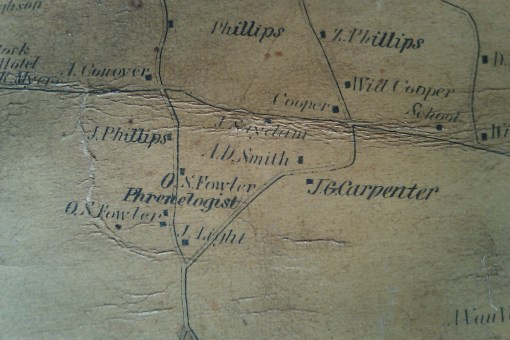
In addition, I added several unique takes on the earliest popularity of the physiognomotracers (aka physiognosotracers), reviewing why they were so popular locally, how the military made use of this school of thought, and why it allowed Dr. Gall’s interpretation of the same to lead to the development of phrenology, a belief promoted most by the Fowlers of New York City and Wappingers Falls and which became one of the most important alternative medical philosophies in Hudson Valley history prior to the Civil War. 

A little more confirmation of the links that I propose exist between Cadwallader Colden’s metaphysical philosophy and the development of homeopathy are provided.  Hahnemann’s work is a variation of some of the explanations Colden provided for how and why inoculation worked.   The general philosophy for  the time during the post-Colden era is reviewed as a connector for the philosophies preached by French Luminate and believed in by such European physicians outside the French communities like Hufeland and Hahnemann, between 1796 and 1810.  This page is mostly a biography of Christoph Wilhelm Hufeland and his popularization of once fairly common natural healing traditions still practiced today –“Heilkraft der Natur” or vis medicatrix naturae.   Both Hufeland and Hahnemann played very important roles in the recreation of the popular vital force theory believed in since antiquity, but made popular in America as a medical philosophy by physicians like Dr. Osborn sometime around 1760 by Theophilis Borden (1722-1776).  The influence of the military on these healing trends are demonstrated by the development of early gymnastics (exercise) therapy and specific eating practices (the early diet therapies) (see Anton de Haan, Dutch medical philosopher, popular from 1740 on, but also see more details on the same by the inventor of “Sports Medicine” in the United States according to many–Shadrach Ricketson).

. . . from the page “Divine Psychiatric Truth”

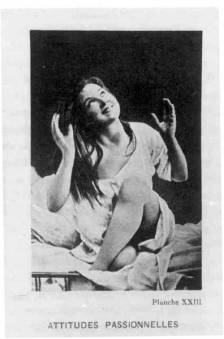
I have also reviewed the unique story of a gifted girl, Rachel Baker, who came to Poughkeepsie ca. 1815.  She had a disease that we would today consider “culturally bound”, but only during her lifetime.  To have a culturally bound syndrome means that those of your culture believe this is the condition you have and so you manifest it.  Even the physicians believed in Rachel Baker’s problems, and were an important part of the culture defining the possible  existence of such a medical condition. The philosophy and interpretation of  psychological, psychiatric and psychosomatic states today might classify this disease differently, perhaps as some form of epilepsy and/or hyperreligiosity.   The contemporary interpretation of the scientific findings for the time (1812-1820 medical philosophy) defined this type of disease she had based on the contemporary professional interpretation of such events as  suspended animation, somnambulism, and “mania”.  

Rachel’s case of “divine somnambulism” is an example of how so often we based our supposed scientific diagnosis on contemporary scientific philosophy, not necessarily scientific proof.  More importantly this diagnosis is based on a review of one of the most important New York and Hudson Valley physicians for this time, Dr. Samuel Mitchell, a natural philosopher and a believer in evolution and phlogiston–that undiscovered element of nature that may be responsible for disease, an editor of Medical Repository.   Mitchell was so highly favored and respected as a physician due to his position as a New York State representative, and his influences internationally as one of the key political forces for his time, someone we rarely ever hear about.  

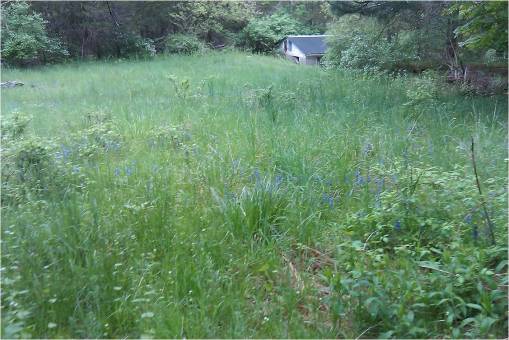
Regarding the old history of the valley that I grew up with, and now appears to be nearly lost or forgotten  I reviewed an important historical site I came upon while searching for some old Indian graves.  This house offers us a unique look into the past, but unfortunately it was riddled with antiques left to decay.  Some of these pieces from the past are more than 100 years in age.   This site (noted at the very top of the list along the right margin), represents four periods of local Hudson Valley history followed by a period of what appears to be its final ownership:

  • 1790/1800-1840–original settlement by the true “last of the Mahicans” ,
  • 1840 to about 1890–development into a local hotel and boarding house continuously owned and operated
  • 1890-1930–development into a motel for tourists to stay in after a carriage or stage coach trip, and decades later, the first long drive by overlander and Model T Fords from New York City,
  • 1930 to about 1960/1970–a period of development into a unique motel with coal-heated water and a traditional horse and plow farm,  as a part of FDR’s “New Deal” and “Farm Act” of 1933; FDR accompanied these changes with plans (first developed 1917-1925) to reconstruct the old roads in the vicinity into a more direct tourist route (see http://en.wikipedia.org/wiki/Taconic_State_Parkway).   [This tale to be continued – – I have  a diary of a local resident one or two hamlets over from this place for this time frame as well for further insights.]
  • 1960-1980–final ownership(s), ending ca. 1980, including by a private land and home owner (d. ca. 1980-2) from the New Jersey area.  (I have not yet reviewed the current plans for development or use of this land.)

Quite recently, writer Judith Curry posted an article citing my coverage on “Global Warming – Part 1“, posted in winter 2010/2011 along with a more detailed essay on “Deforestation and Global Cooling . . . ” and how this resulted in Noah Webster’s claims for local cooling which in turn led to the development of the local merino sheep industry in the Hudson Valley.  Ms. Curry provides us with a very nice synopsis on this important piece of American history, which she posted in turn as a response to a Smithsonian brief on this topic published separately in just a couple of weeks ago in mid July 2011.   Since the most recent author failed to mention the sources for this work, just to set the record straight, it should be noted that this notion of climate change and global warming defined as early as 1790/1800 was previously published in 2009.  

As usual, my hexagonal grid analysis methodology and related excel worksheet download, and my various historical maps, are my most frequented sets of pages.  The most common topics perused by visitors of this site remain those which were previously noted, with the addition of GIS related Risk Management pages, which have doubled in attendence in recent days and weeks. 

As an aside, for those into GIS, as part of my population health risk management work, there is this method I created (and posted, except for the formulas) for performing exceptionally large population analyses by applying a raster GIS/RS moving windows formula.  One can analyze two very different population sizes, previously considered unmatchable due to variance and standard deviations, to determine where statistically significant differences exist.   Once I integrate this into other GIS applications, the overall GIS risk management and population age-gender health analysis processes  will be improved.

.

Relative Prevalence, StatSig and LogSig rates for various ICDs based on a 2004/5 Population Study

Medical Geography and the History and Anthropology of Medicine and Public Health

This site is focused on information, information sources and discoveries that I have made over the years trying to promote the study of medical geography. Since medical history is my strength (other than a few science- and public health-related specialities some readers will pick up on), much of what I am writing are essays on my findings during the past 30 years researching the history of medicine, in particular New York and Hudson Valley medicine, and especially irregular, alternative or complementary medicine. (I save the term integrative medicine to refer to something else, not yet fully existing.) I researched and taught this information at Portland State University for nearly 20 years.

And so what have I recently covered and/or published at this blogsite?

The following are some of the new topics just posted or about to be posted:

  • Open Letter to New York State Commissioner of Parks [the need for a Fishkill Revolutionary War Visitor’s Site]
  • A few more historical disease maps.
  • The brilliant ceramic artwork of Huguenot Naturalist and Natural Philosopher Bernard Pallisy (late 1500s)
  • Dr. Robert Todd, Fishkill, and his “Metalic Points”, 1797
  • New York’s Dr. Samuel Mitchell, naturalist and phlogistian (ca. 1800)
  • The James Way“–the public health and sequent occupance for a local 1940s-1950s Turkey Farm recently revisited (many pictures)
  • From “New Eclectics” (1878) to the modern day practice of Naturopathy (Portland, Oregon)

Speaking of complementary or “non-allopathic” medicine, the following is the basis for a traditional citation often referred to by writers discussing this pop culture topic–the various forms of medicine out there today . . .

And Moses stretched forth his rod over the land of Egypt, and the east wind brought the locust. And the locust went up over all the land of Egypt; before it there was no such locust, and it did eat every herb of the field, and afterwards Moses stretched forth his rod, and the locust was cast into the Red Sea (Exod. 10:12).

I am trying to make sense of a commonly cited reference posed by recent writers about regular and alternative medicine. They probably do not realize that they are referring to the above quote from the Bible whenever they quote an attractive line penned by the famous writer of American Colonial history William Smith in THE HISTORY Of the PROVINCE of N E W-Y O R K, FROM THE First Discovery to the Year MDCCXXXII. To which is annexed, A Description of the Country, with a short Account of the Inhabitants, their Trade, Religious and Political State, and the Constitution of the Courts of Justice in that Colony (Printed for Thomas Wilcox, Bookseller at Virgil’s Head, opposite the New Church in the Strand, in London. M.DCC.LVII (1757)). I am referring to the following phrase that appears in Smith’s writings about the physicians practicing in the colony of New York around 1750.

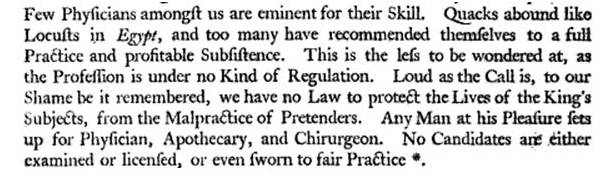
“Quacks abound like Locusts in Egypt”

This commonly cited phrase comes from the following paragraph in Smith’s text:

There are some phrases or lines we are can be drawn to as writers, like a fly to flypaper one might say, or in the case of writers, a lonely sheep returning to its flock. After several days of constantly finding references to this particular phrase about two months ago, I decided it was time to research the various applications, and misapplications, of this phrase over the years. I was wondering, ‘are these writers citing each other, with little knowledge of what it is that they are citing?’

Samuel Bard

This phrase was originally used by Smith to refer to “doctors” who were for the most part trained or apprenticed in the Colonies, versus what he considered to be “better doctors”–those who were trained either as an apprentice in some office, by a school, and/or by a teaching hospital setting in England. At the time Smith wrote this claim, he failed to mention any of the activities engaged in by one of the most famous physicians for this time in New York–Dr. Samuel Bard of the City of New York. Loyalism had not yet come to bear as an important part of American culture and history, but the Stamp Tax act that resulted in the separation of loyalists from patriots was just a couple of years away once Smith’s book got published. Smith’s comments referred to the superiority of English-trained doctors (and perhap Scottish-trained or even other Western European trained physicians) over American-trained physicians. Apparently, most of the writers citing Smith’s famous line were unaware of this important piece of American medical history, generalizing it to refer to non-allopathic practices in the early US in general, not necessarily “quackery” since allopathy was often at fault just as much as its competitors.

[see http://civilwarmed.blogspot.com/2009/05/medical-department-25-civil-war-snake.html]

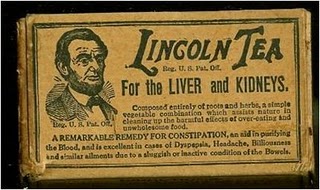
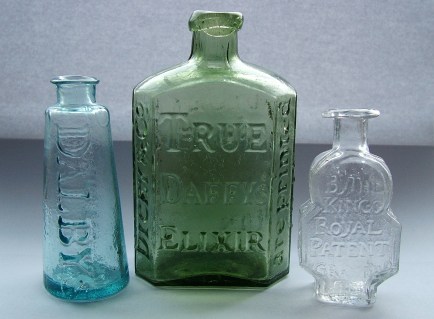
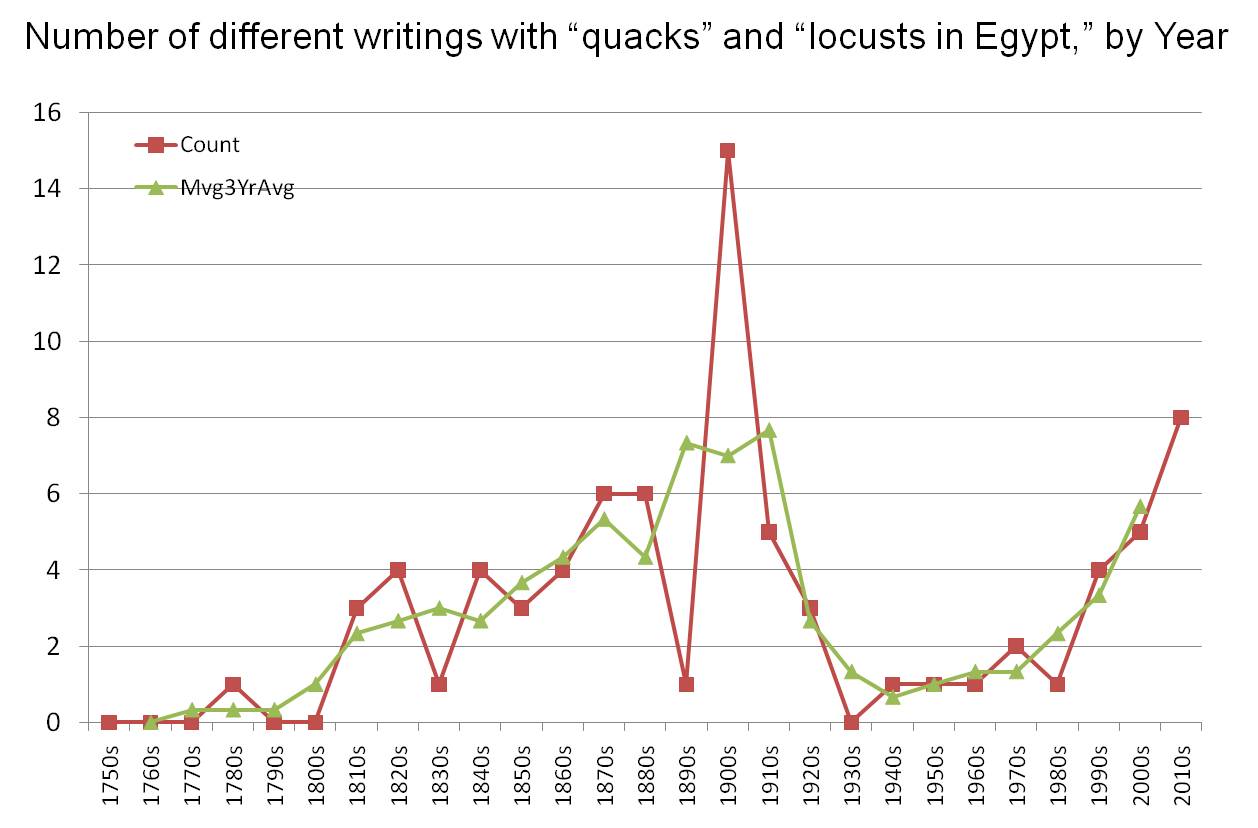
By far the most popular time for Smith to be quoted in the medical journals was the early 1900s, and came in reference to the problems of “quackery” stirring around the turn of the 20th century due to Patent Medicines. The most common year that this statement was cited was 1905/1906, the year the Pure Food and Drug act was discussed and passed. The Food and Drug Act was succeeded by the Food, Drug and Cosmetics act in 1915. The purpose for each of these laws was to manage the mislabeling going on since the early 1800s. These acts outlawed the sales of medicines that had certain drugs in them like the various forms of opium (with one or two exceptions, for example “heroin” was still available OTC and not excluded by this bill). It required the labelling of a remedy’s mysterious ingredients, and was an attempt to control the types of claims made on these labels regarding the many diseases a product was claimed to treat. This is like the problem we see today with certain medications claiming they help reduce the risk of heart disease when there is absolutely no statistically proof that taking these medications accomplishes that (i.e. the recent FDA statement about this regarding certain lipid and blood pressure lowering drugs)–it is just something some doctors want to beleive in and pass on down to their patient.

These applications of Smith’s statement had nothing to do with non-allopathic medicine. They had everything to do with regulating over-the-counter pharmacy. Although a controversy concerning non-allopathic training was once again taking main stage around this time, this was never the main attempt of the 1906 law and so William Smith’s 1757 claims had nothing to do with it, even though the writers wanted to think that it did.

In addition to the above finding, my study of the misapplication of Smith’s line also revealed that a number of times that Smith’s phrase was used as a result of a writer “borrowing” or plagiarizing this statement from another writer. They did not necessarily plagiarize Smith’s words. They pulled the statement from the writings of another author, citing neither Smith nor the later authors. To the novice reader, this can make it appear as though these writers were the creators of such a phrase along with its attached meaning and discovery, suggesting as well to these readers that this author deserved some sort of pat on the back for his or her discovery, and for daring to make such an opinionated and political statement about this controversial issue. This serious misuse of another writer’s discoveries begs the questions ‘Can we believe any of the other findings made by the writer?’ and ‘Is everything else this author writes about based on unreviewed resources?’

.

Of course, the writing profession does have certain cases where citations are not appropriate or necessary for the particular article they were asked to produce. Setting this matter of “borrowing” and potential plagiarism aside, the reference to “Quacks” still made today in terms of non-allopathic medicine is really old hat. This kind of authorship is a sign of outdated intelligence. Unknowingly, the writer who uses this citation is telling us that he/she is probably not familiar with the non-allopathic profession, but more definitely that he is not read in the classics as much as he should be. This only results in more mis-citations as time passes, which the author is now a new example of. For example, in one such case we can find a citation originally made in 1757 for the first reason (British vs. American), becoming information that is applied by another person in 1906 for a second reason (reference to the over-the-counter drug patents), which several citations later, has lost its original meaning and is misconstrued or misappropriated (herbal medicine is bad). This new application does not at all match the original author’s intent, nor can it even be related truly to the current situations at hand. Today, Smith’s phrase is now being cited in reference to the development of complementary or integrative medicine, a far cry from the original quacksalvers, mountebanks and, oh yeah, American physicians whom Smith was referring to in 1757. True, it is closer to the original intent of 1757 than the popular 1905/6 use was, but do these writers really want their judgments made on non-allopathic medicine to be linked to some Bible quote about Moses? Do they want us readers to think of them as the next Moses, Smith, Young or Fishbein strongly rebelling against “irregular” medicine? (The next P.T. Barnum?)

This continued use of the word “Quacks”, with reference to Smith’s famous line, is something that modern society has outgrown. The words “quack” and “quackery” valid 50 or 75 years ago are very much outdated today. Society has become more mature one might say about this issue. The original cultural constructs for which this this word and cultural statement were intended are long gone. So today, when this historical statement is used, it is most often wrongfully applied to refer anything that is non-allopathic medicine, be it truthful or not. This is particularly the case when the critics don’t have an inkling of an idea about the contents of the philosophy they are talking about. I have to question the intellect of someone who denounces something like the theory that EMF could be a cause for fibromyalgia and acupuncture a possible treatment but cannot tell me whether the energy being produced by his scanner is discrete or sampled, or based on ‘nup’ or ‘sup’ (north up coils or south up coils).

It was different back in 1906 because then the critics were referring to the misuse and mishandling of chemicals, and only in some cases fraudulent claims regarding a physiological or pathological change that could not be made to happen, such as the instant curing of a cancer. When writers today use the terms “quack” or “quackery”, they are also telling us that practicing some form of medicine based on philosophical beliefs such as Vitalism, the balance of the four humors, Chi, Yin and Yang, Vata, Pitta and Kapha, Homeopathy, herb- or crystal-related energies, garden angels, dowsing and channeling with nature for the benefits of our innermost being are wrong. They forget that this also pertains to all non-American, non-allopathic traditions as well, like those practiced by Jewish, African, Carribean, Hoodoo, Hispanic, Hindu, Ayurvedic, Unanic, Chinese, Buddhist, Kampo, Celtic, Aesculapian, Phillipine, Hawaiian, Inuit, Metis, Navajo, Mayan, Scandinavian, or even Viking cultures. Does this mean that since these people are also practicing some sort of medicine which the writers don’t believe in, that it is quackery and shouldn’t be allowed?

James Harvey Young (1915-2006).

In my first days in medical school, I happened to meet the second historian to make the term “quackery” what it still is today for many people–James Harvey Young (for a biography see http://www.historians.org/perspectives/issues/2007/0702/0702mem3.cfm). One of the first readings for the special interest group I was in at medical school was his book on quackery–The Toadstool Millionaires. A Social History of Patent Medicines in America before Federal Regulation.

James Harvey Young’s writings about quackery and their effects on Americans and medicine were preceded and surpassed only by the works of an even more prolific speaker and writer of this field of the early 1900s, someone who represented the AMA and was the original editor of the pop culture trade magazine Hygeia. He was the infamous Morris Fishbein (similarly, see http://educate-yourself.org/cn/morrisfishbein05feb02.shtml). When I first began my work in the field as a student of medicine during the early 1980s, Fishbein’s books were the rage I was told and his books could still be found in nearly every used book store. Of course their presence in the used book world probably meant thay they had outgrown their original owners’ needs and interests of 30 or 40 years ago. But due to Fishbein’s writing style they were still pleasurable waiting room readings during the 1980s, much like they were to the “millions of readers” who decades before me perused Fishbein’s popular magazine Hygeia in much the same way, and in much the same type of physician’s office setting as well as at home.

Morris Fishbein (1889-1976)

The regularly distributed magazine Hygeia was kind of like the Weekly Readers or Highlights magazine one always found hanging around the waiting rooms at doctors’ and dentists’ offices. It was sent to as many people as possible, for free on many occasions. It focused on the importance of preventive medicine, hygienic practices, the value of immunizing, how to engage in the most appropriate exercise programs, developing good dietary behaviors, and all the other skills or lessons a doctor was said to be professed in, the knowledge base for those skills he or she was suppoed to provide to unsuspecting patients. But it is also important to keep in mind that an equal number of articles in Hygeia pertained to the numerous “fallacies” out there about health and hygiene. There was a special topic of this sort covered in each and every number produced, along with a matching editorial section Fishbein was in charge of. In this part of the magazine, the writer provided his reader with a unique and highly opinionated reports on some form of malpractice or “quackery” out there, reviewing such controversial topics as electrotherapy, herbal medicine, astrology and health, hypnotism, religion and medicine, and one of the worst “evils” known to man–homeopathy.

[Published from 1924 on, the current version of this journal can be accessed at http://www.hygeiajournal.com/. For origins and culturally-defined meaning in relationship to this journal title, see http://www.sciencemuseum.org.uk/broughttolife/people/hygeia.aspx.]

At the time Hygeia was first published, the popular practices like homeopathy and eclectics were in their final years, at least for their generation of medical schools branded as “alternative”. The new schools of naturopathy had just been born and were about to blossom (this is reviewed extensively and posted near the end of my lengthy list of topics). Were it not for the hygienic movement taking place in the 1920s and 1930s, naturopathy could have been well on its way to becoming its own self-sustaining practice by the 1950s. Instead, unfortunately, due to lack of financial input and political support, this profession was forced to take the stage alongside chiropractics for a while, terming itself “drugless medicine” while it taught its philosophy at the same schools that taught chiropractic medicine. This “mixed” schooling, as politicians called it, persisted for just a decade or two, and was forced to cease its operations once the problem of defining immunizations as a form of drug delivery came to court. [See Utah studies posted for more on this]. This led various government agencies in charge of overseeing accreditation processes to threaten the chiropractic profession with shutting its doors if this mixed form of schooling and licensure process continued.

Photographer Doug Beghtel/The Oregonian. Article’s author: Andy Dworkin. “New Clinic Opens at Portland College of Natural Medicine.” Published: Wednesday, September 30, 2009. Subtext for photo: “Students Tim Rudowsky (left) and Matt Elliott weigh and mix kun bu, or medicinal kelp, and other Chinese healing herbs in the medicinary of the new clinic at Portland’s National College of Natural Medicine.” Accessed on 3-25-2011 at http://www.oregonlive.com/health/index.ssf/2009/09/new_clinic_opens_at.html.

Time has of course allowed for a total reversal of this age old controversy. Today’s naturopaths have several licensed and accredited schools out there, with federal student loans available for those engaged in this particular form of medical education. This is all due to just the one school that persisted its operations throughout the 1960s and 1970s. Due to the passage of time, and changes in public perception and attitude, naturopathic doctors who earned an official ND status from an accredited school could once again engage in certain clinical practices that they were previously excluded from more than 50 to 60 years ago. (I underscore this because there are many learn at home NDs also out there who learned via mail from a non-accredited institution. For more on this accredited school and its licensed profession see http://www.ncnm.edu/.)

Suffice it to say, the “drugless medicine” of NDs is once again very popular, be it in the form of Chinese medicine, Ayurvedics, some 19th century form of herbal medicine, movement therapy, or even at times practices akin to the most modern products of allopathic pharmacology. Were it not for the invention of bioengineered drugs by allopaths, medicines designed to target specific parts of the body, today’s practice of allopathic care might appear at times to be something more and more like the “pharmacy” of its complementary medical field at times–naturopathic medicine. A number of MDs practice according to their own philosophies on the nature of health, which they either rediscovered or discovered for the first time, a knowledge of the past brought back into the modern era of “reformed” medicine. At times it seems the only differences between some of the more esoteric preachers of allopathy (those “certified” as homeopaths, nutraceuticalists, acupuncturists, environmental medicine specialists, nutrition doctors, sports medicine physicians, physical fitness doctors, some new age psychologists or psychiatrists), and the most traditional forms of naturopathy, are the “religions” or philosophies each of these classes of new physicians base their practices upon. When it comes to health maintenance and helping a patient find his/her best treatment plan, the knowledge of one practitioner can sometimes complement the preachings of the other. It’s funny how they never seem to effectively teach this in regular medical school.

To me this means that relating “quackery” to most of America’s modern alternative medicine is a vision of the past. Of course there is still true “quackery” out there . . . the poorly supported, misaligned claims made by “doctors” of any shape or form. For example, there are still people out there trying to claim they have found the magical cure to remove your skin’s blemishes as well as treat cancer, or claim they can change your appearances into someone who is 20 years younger, and of course there are the healers out there who claim they can manage to tell you all about your medical fate based on some test of the crystallization of your saliva, an analysis of your sweat to determine what substance your body is lacking, a review of your allergy-antigen history by means of a simple muscle test, or use a scan of your entire body’s physical and energy state or “forces” using nuclear magnetic resonance to interpret the “vibrations” produced by its water content (not Kirlian photography, but MRI, the nobel prize winning discovery of one of my chemical teachers at Stony Brook, Paul Lauterbur-see http://en.wikipedia.org/wiki/Paul_Lauterbur). Note: none of these claims are really promoted by any of my writings at this blogsite. So ‘rest in peace’ those of you who are trying to figure out whether or not I am someone who is willing to throw away the baton in the race to medical, political supremacy, or engage in my own form of unique form of the popular health culture. My work is focused on the philosophy of medicine in general, not just alternative, complementary or integrative medicine, but medicine in general.

Perception and prejudice are everything when it comes to formulating and acting upon one’s own opinion about “facts.” I once had this survey I always handed out at the end of the chemotaxonomy/ethnobotany classes I taught at Stony Brook and Portland State Universities. One of these questions asks students to define what side of the field I appear to be on regarding non-allopathic medicine. In other words, ‘Am I for or against these different forms of medicine I am teaching?’ The response options for this question ranged from strongly pro-alternative to strongly pro-allopathic, with the choice of a neutral score placed in the middle of the Likert response scale I provided them with. It always felt good to see that no one really knew where I stood in this matter. All of the possible perspectives of my work were out there.

It has been a while since I last added anything to this section. I pulled together some of the work I was doing on medical history when I was teaching the courses on trapper medicine, Oregon Trail medicine and the history of alternative medicine in this country from the colonial years to present. Fortunately, were it not for some PC and IT geeks back in the early to mid 1990s, much of this information I developed on a my 1982 Sanyo MBC 550[CPM/SYS]/11″ wide daisy wheel printer and my more normal 1992 IBM 286 [DOS] would have been lost and forgotten.

Most of what is posted here is research that has been ongoing for about 20+ years (talk about OC). If any of you have read the results of my work on the Dutch-English raised Revolutionary War physician Dr. Osborn (1722-1782), you can see how being patient pays off. It took me more than 20 years to solve the riddle about why an 18th C physician in Hudson Valley, New York was practicing alchemy by using a compound called Ens veneris–a compound then considered to be the elixir of life or philosopher’s stone.

DrCorneliusOsbornManuscript_0069

Treatment for “Stoppage of the Terms” (a late menstrual period), 1768

I spent twenty years wondering how he came up with this recipe. I could not find it anywhere in the published books. The closest thing out there in the rare book rooms was Robert Boyle’s letter to a friend in which he mentions ens primum veneris, not ens veneris. It was obvious to me this was not the original ‘essence of venus’ as defined by 16th C. alchemists like Paracelsus. For one thing, both Osborn’s and Boyle’s recipes were made with iron instead of copper. The feminine metal of Venus, copper, is needed for the entia or “essence” of venus to be extracted; the metal Osborn and Boyle used, iron, is the metal of Mars and symbolizes the male spirit.

Once the internet was discovered, some time in the Spring of 1990 in my house, I began to discuss my findings with others at some of those old fashioned posting sites. (All of those good old alternative thinkers from the Pacific Northwest in Portland, Oregon.) The mainframe for this internet site was at a neighbor’s house, which I hooked up to by telephone. (What fun that was!)

Robley Dunglison’s A Dictionary of Medical Science … 1874

Then, some time around 1995/6, I upgraded to a Windows 95 laptop and began periodically visiting the AOL, Yahoo! and Netscape search sites. The very first time I was there, and every now and then afterwards, I’d type in “ens veneris” only to get no hits. (My only hit in 5 years was for a dictionary note on the entry “ens”). Then about three or four years ago, and several generations of PCs and laptops later, I typed in “ens veneris” and out came thousands of hits. I knew something had just happened that was about to answer all of my questions.

It ended up Dr. Osborn probably learned this through oral history, due to the local Dutch fascination with mysticism since their first settlement in the Hudson Valley around 1640. The inventor of this ens veneris was George Starkey, a Bermudian chemist who moved to Cambridge, Massachusetts in 1649. While a student at Harvard, he developed this formula in his alchemical lab. Once people learned more of the details of Starkey’s experiments, his notes were put into storage at a library in England and this little piece of American history was lost and forgotten. Fortunately, these notes were re-discovered a few years back, and subsequently translated and published. Starkey’s invention of ens veneris was in there.

Portrait of Robert Boyle, by Johann Kerseboom

Robert Boyle

(NOTE: most of these portraits are from Wikipedia)

By reading the manuscript you can immediately tell that Starkey was a Christian Alchemist who “channeled” with God for his recipes. In 1651, Starkey moved to England due to some communications he had with one scientist in particular who was about to become one of the most important chemists for his time, Robert Boyle. Like other scientists, Robert Boyle probably saw Starkey’s notes, read his recipes, and then stopped communicating with Starkey once he began seeing comments inferring these recipes were revealed to him by God. Boyle and others left Starkey behind for years to come, as well as most of his discoveries for Starkey to contemplate and rediscover on his own.

Meanwhile, Boyle successfully modified some of Starkey’s recipes and then published them himself. Evidence for this is noted in one of Boyle’s letters to his associates in the field, in which he defines for the first time “ens primum veneris.” Back in 1987, I couldn’t link Dr. Osborn to Robert Boyle or Boyle’s version of this alchemical term. But once I learned about Starkey’s local fame at Harvard, the method Osborn obtained this knowledge became clear. Starkey was still favored by some of the more metaphysically-minded settlers of a primarily Dutch environment. Dr. Osborn was considered by historians to be a “Vitalist”, a follower of Theophilis Borden’s teachings which stated that the organs have their individual life energies that must work in harmony for the body to be as healthy as possible. So be it. Whereas the Swedenborgians for this time had their angels telling them what to do, the true Starkians simply had God. And some residents of the Hudson Valley like Dr. Osborn became the first in North America to believe in the vital force.

So ends my saga of finding out where the philosopher’s stone recipe for the small town of Fishkill, New York came from in 1768, seven years before the dawn of the Revolutionary War. [For more on Starkey begin with Wikipedia’s Eireneaus Philalethes, “the peace lover of truth.”]

One of Andrew Jackson Davis’s seancing sessions in the Hudson Valley, from his book on this topic.

For those perusing this page out of curiosity (to see just who it was that produced these pages) the following are the additions to my projects in recent months:

  • Evidence supporting the need for veneration (beatification?) of local Mahecan Sachem Wasamapa (aka Tschoop/Job or Brethren John of the 1740-1745 Moravian Missions), the next Native American to begin a path towards sainthood. [The first to nearly reach this level is Blessed Native American is Kateri Tekakwitha.]
  • More definitive proof that Cadwallader Colden‘s philosophy facilitated or led to new faiths being practiced in the Hudson Valley, esp. local medical electricity and the underlying Lamarckian, pre-Darwinian evolution-creation theories for the time, that Colden may have even helped generate.
  • More on Poughkeepsie Thomsonianism.
  • Some notes on the Octagon House in Wappingers, a forgotten piece of local history. Its owner, designer and architect, Orson Fowler, was a popular speaker in what is now the Greenwich Village area. This house is where some of the first metaphysical forms of alternative medicine were philosophized and practiced in this country. Due to a book Orson Fowler wrote on this house, the octagon houses still standing have received national recognition. This is the place where early vegetarianism was practiced, and where vegetables grown in the garden made use of human waste as fertilizer, taken from the earth closet Orson designed. According to an 1850 map in my possession [see below], this is where Orson Fowler and others preached and practiced phrenology. It is probably where Andrew Jackson Davis performed some of his local seances for the first time as a “New Age” Metaphysicist, is where Dods taught Electric Psychology, and is where people were taught to get back to nature. Orson Fowler’s Octagon House site deserves national and New York State historical site recognition.
  • Rev. John Bovee Dods’ early 1840s sessions on electric psychology and magnetism (wearing galvanism pendants), including the notes of one of his students on how to read someone’s energy by palpating the wrist.
  • For genealogists, I have put out there some more on the history of medical licensure and the names of physicians locally, esp. in the valley, ca. 1800-1820
  • I also finally found my notes and floppies with the documents detailing the history of trapping and exploration and the development of the trapper’s unique natural philosophy; this includes the details of a number of writings I reviewed on trappers and health, and how a trapper practiced medicine at the various stages in American trapper history, 1745-/1790-1860
  • I added a new section on Oregon Trail Medical History, including the start of a natural history review of the trail with documentation of the possible milksickness epidemic region along the Trail due to a Eupatorium species
  • I made some initial entries on the Pacific Northwest history of alternative medicine, in particular trailblazer and Eclectic doctor John Kennedy Bristow (1814-1887); the Pacific Northwest is where the accredited version of naturopathy was rejuvenated around 1956 in Portland, Oregon (at National College of Naturopathic Medicine, Portland, OR, not the John Bastyr College in Seattle, which began as a branch of NCNM ca. 1973).
  • Finally, I had to get to this theory I found in the medical literature out there for others to read; Noah Webster (of Webster’s Dictionary) published a theory on the potential impacts of the first global climate change due to deforestation back around 1797-1810; his theory was that the earth would cool down due to lack of forests!


.

From Map of Dutchess County New-York, from Original Survey. J.C. Sidney C.E., Author of 12 Miles Around New-York. John E. Gillett, Publisher. 1850.

.

1850 Street Map of New York City by Samuel Augustus Mitchell (The Gangs of New York movie was set here)

.

I have also begun adding my popular text-book entitled The Evolution of Plant Chemicals. [This will take a while.] This book was quite popular during the years I taught my course on this topic (1989-1993, then 1995-2002, on and off). Note: this textbook sometimes sells for fairly ridiculous prices in Europe (>100 Pds). To the right scientists, this kind of information I developed can be a time-saver.

For those who took the Chemicals in Plants course I taught at the university back in the 80s or 90s, I plan to add and publish the results of this work on the ethnobotany/chemotaxonomy tables via this site. I have since then developed several unique approaches to presenting this information using the Plant Evolution Chemotaxonomy Tree I drew up more than 20 years ago (to those who know what I am referring to: sorry, the full tables themselves will probably not be presented due to too much information on a single page, lack of space and readibility issues). Overall, my students back then have found my course book to be a very nice summary of how and where the different types of chemicals exist in the Plant Kingdom and how to go about better understanding them, their reasons for evolution and their ethnobotanical and medicinal values. I highly recommend this to university individuals into ethnobotany, herbal medicine practitioners, and individuals researching bioengineering and tissue culturing plant medicines and other plant products (the reasons I wrote this book in the first place back in the late 1980s).

.

Grid Cell and Moving Circle Cell sizes Relative to Portland Research Area

.

Based on the recent site statistics, my most popular topics being reviewed by site visits are as follows:


Interestingly, due to the recent news that Venerable Pope John Paul II is being considered for beatification and possibly canonization, I am getting a lot of visitors to my pages about the makings of a saint and the psychological process of self-discovery which many of these people go through.

Global Warming, Part 1

Now on to the main topic that brought me back to this section in the first place. There is this article I came upon about a year or two ago on global warming. It was published by the Medical Repository and distributed out of New York City in 1810.

I like call this little bit of medical history trivia ‘Part 1 of the Global Warming-Deforestation issue’, inferring of course that today’s global climate change events are ‘Part 2’.

In 1797, Reverend Samuel Williams (1743-1817, sorry, no portrait) wrote a book entitled Natural and Civil History of Vermont (2 vols). In this book he provided a detailed description of the Vermont topography and climate, and made use of his astronomy skills to define the boundary of Vermont with Canada. Ten years before this book became famous, Reverend Samuel Williams of Massachusetts was a Harvard student who graduated and became a professor in philosophy and mathematics. In 1788, he was forced to remove to Vermont due to a financial scandal related to misappropriated funds. In Vermont, he worked as a Congregational minister for seven years and with his cousin, Judge Samuel Williams, helped found the University of Vermont (see http://cdi.uvm.edu/findingaids/viewEAD.xql?pid=williams.ead.xml). During his years in Vermont, two of Williams’ major areas of interest were the theory for the formation of the earth and the fossil records, both in relation to what would later be called evolution. Reverend Williams work on this subject resulted in considerable support for his work, and a considerable amount of criticism from at least one scholar residing in the adjacent states of Connecticut and New York–Noah Webster, author of Webster’s Dictionary.

James Hutton

At the time there were the Uniformitarianists led by James Hutton (1726 – 1797), who believed that the present world evolved at a fairly constant rate over very long periods of time. They liked to explain the changes in the earth’s surface based on its geological layering as the result of natural events such as volcanoes, earthquakes, floods, rain, wind and erosion.

Georges Cuvier

Opposing the uniformitarians were the Catastrophists headed by Georges Cuvier (1769 – 1832). The catastrophists believed in creation, the Great Flood, Adam and Eve, and of course, God. Supporting the catastrophists’ theory was the discovery of the fossil beds, the more complex examples of which were found close to the surface. This resulted in the principle of superposition, which implied that old organisms were destroyed and with each period of destruction replaced by newer organisms designed by the Creator that were more sophisticated in their form and nature. This theory suggested that a number of periods of drastic change or catastrophes had taken place–natural catastrophes like the more recent Great Flood produced by God.

Like the other catastrophists, Williams was aware of the climatic differences inferred in the Old Testament when two different historical recounts of the same region were reviewed for two different time frames. Such was the case for a review of the Book of Job by Moses and the writings of David composed 400 years later. Williams believed that the meteorological evidence contained in these two stories indicated that a warming of Palestine had occurred, which Williams claimed was due to deforestation. This deforestation process he claimed is what caused the greater seasonal changes in wind patterns and temperature being noted as time passed, causing some areas to become colder than in the past, and other areas much warmer.

Painting of a portly gentleman in a powdered grey wig and richly embroidered clothes.

Comte de Buffon

Other Bible historians who believed in this theory at the time included the famous French naturalist and pre-Lamarckian Georges-Louis Leclerc, Comte de Buffon (1707-1788). Buffon was the first to propose a theory considered very close to Darwin’s theory of evolution. Also supporting the belief in climate change during the Bible years was Scottish naturalist and philosopher David Hume (1711-1776) and a theologian noted by some writers as Dr. Holyoke (probably Edward Augustus, 1726-1826, but could have been his father Edward, who was once President of Harvard. See http://www.salemweb.com/tales/holyoke.shtml and http://www.springerlink.com/content/x38261043t1l9436/). Dr. Holyoke popularized the theory that the large evergreen forests could be related to these climate changes noted in the Bible for some regions, claiming the removal of these trees is what led to much warmer summers and much colder winters.

David Hume

Each of these scholars were drawn by the natural philosophy inferred by the following quote contained in the Bible [Psalm 147:16-18]:

“He giveth snow like wool; he scattereth the hoar frost like ashes; He casteth forth his ice like morsels; who can stand before his cold? He sendeth out his word, and melteth them: he causeth his wind to blow , and the waters flow.”

To prove that Buffon, Hume and Holyoke were correct, Reverend Williams made use of his meteorological training from Harvard to compare the weather and climate descriptions found in the Book of Job by Moses and the writings of David composed 400 years apart. The common belief then was that both Moses and David resided in the same place when they wrote their stories down–the land of Midian or Palestine. Comparing these two authors’ entries about the snow patterns observed for the region, and their details as to whether or not the local rivers were completely frozen over, Williams was able to determine that there was a 6 degree increase in the winter temperatures over the 400 years that had passed. In Palestine, the climate was getting hotter over time.

Jean-Baptiste Lamarck

Williams publicized this detail about a possible warming of certain parts of the earth, due possibly to wind changes and deforestation. During this time, medical climatology was the ‘buzz word” for the medical profession. Disease was no longer a problem related just you as a person. It was now a product of the local environment and whether or not you were adapted to living in that environment, a product of Lamarckian philosophy and theory developed by Jean-Baptiste Lamarck (1744-1829). One of the most important questions a doctor could ask his patients at the time was: ‘Are you and your parents acclimated?’ If the parents were acclimated, than according to Lamarckianism the children were also acclimated and in much stronger health; if not, then it was going to be a struggle for you and the kids to try to adapt to this new environment in the United States for the next generation or two.

Thomas Malthus.jpg

Thomas Robert Malthus

Accompanying the theory of Lamarckianism was the philosophy of Thomas Robert Malthus (1766-1834). In his An essay on the principles of population, he wrote that the population was growing at a faster rate than food productivity could be increased by the farming industries. This meant that as time passed, more people would most likely succumb to starvation and become more susceptible to disease. This in turn would play a role in the ever-changing political powers of the various national governments. Therefore, the goal of governments was to keep its people poor and repressed, by offering limited food stores. The most important statements in his 1798 essay:

“That the increase of population is necessarily limited by the means of subsistence,

That population does invariably increase when the means of subsistence increase, and,

That the superior power of population is repressed, and the actual population kept equal to the means of subsistence, by misery and vice.”

Bos primigenius

Both Dr. Williams’ and Malthus’s writings became quite popular over the next few years. William’s writings on climate change suggested to locals that by eliminating the forests of the Hudson Valley, we had begun to pave the pathway towards human destruction. Many onlookers into this scientific dispute were probably thinking ‘No wonder the recent in increase in yellow fever epidemics is happening, on a fairly regular basis.’ [For more, see my” The Trinity Years” and “Poughkeepsie Trinity” under “The Post-War Years”, and “Thomsonian Trinity” in the section “Early Thomsonianism”.]

Noah Webster

This led local expert on climate and disease, Noah Webster (1758-1843, author of A Compendious Dictionary of the English Language, 1st ed., 1806), to make his own comments on Williams interpretations of weather in the Bible. Webster then presented his findings related to Williams’ claims to the Connecticut Academy of Arts and Sciences during a quarterly meeting in New Haven in 1799. Like Dr. Williams, Noah Webster based his results on a review of the Bible, to which he added his own reviews of the natural history of the Middle East and its climate, along with numerous quotes from the work of Hippocrates, various Greek and Roman classical writers, and a number of more recent local natural history findings.

In the end, Webster developed his own theory of climate change. Like Holyoke he blamed it on the absence or presence of vegetation, but differed from Holyoke on the types of impacts this vegetation change was having:

“While the earth is covered with wood, it never froze . . . “.

Webster’s claim was completely opposite of those of Holyoke and Williams. He blamed the climate change in Palestine on the local deforestation that had taken place soon after Moses and the Israelites moved in. He concluded:

“The country therefore could not have been covered with wood, but every foot of land was covered by husbandmen”

and then later adds

“All the alterations in a country, in consequence of clearing and cultivation, result only in a different distribution of heat and cold.”

Seven years later, in 1806, Webster following up this initial speech with a supplement providing further support of his claims. One year later, around 1807 or 1808, Rev. Samuel Williams’ theory about climate change and disease was revived when yet another book on the same controversy was written by John Williams. This book arrived in New York City and made its rounds in the intellectual environment, probably by way of the New York School of Medicine or the local medical journal published in New York, The Medical Repository.

John Williams work only pertained to Great Britain. Noah Webster’s theory pertained to the world as a whole. In America, Webster’s theory won out in the end. Everyone local to his state of Connecticut and the adjacent state of New York believed Noah Webster writings.

In turn, these events led to a revival of Webster’s claim on global climate change. This revival was supported by the republishing of his 1799 speech and follow ups by the Connecticut Academy of Arts and Sciences in their Memoirs in 1810 . Noah Webster’s final belief was that the Hudson Valley like other parts of the world was on its way to becoming colder, a belief published in the Medical Repository as part of a review of Webster’s claims by members of what would later become the New York Academy of Medicine.

The belief in Noah Webster’s global cooling theory and the field of medical climatology were now fully developed. New methods for disease prevention were now being planned for the Hudson Valley. According to some of these believers, the way to combat global cooling theory was also hinted at in Psalm 147:16-18–“He giveth snow like wool . . .” This meant that the establishment of a local woolen industry was now more important than ever for Hudson Valley residents, and to prevent the disease and famine predicted by Malthusianists, the development of a much larger agricultural industry.

Ovis orientalis aries var.merino

This led a number of local families in the Hudson Valley to initiate the local farming and livestock industries for which the Hudson Valley has become quite famous. Along with corn and numerous other crops vegetable and fruit producers, and an entire industry devoted to cows and milk products, came a newly established local wool industry during the early 1800s. This woolen industry was initiated by none other than the Livingstons and was promoted by the Academy of Arts and Sciences. and the local agricultural committee with Physicians, Sheep-raisers, and several Congressmen, including Fishkill physician Dr. Bartow White, one of its first members. According to Minister to France Robert Livingston (1746-1813), in response to one his tours through Europe, Merino sheep from Spain was the way to go. (This Livingston was Minister to France 1801-1804, and very instrumental in the 1803 Louisiana Purchase.)

Chancellor and Minister Robert Livingston

The common belief by many entrepreneurs about the region was that wool was the way to go to save the problems related to the rapidly growing local population. The rapidly growing city of New York had a growing need for farmed fruit and vegetable products and the various dairy products, meats and poultry that the farms of the Hudson Valley could produce. To some this meant that deforestation was essential to meeting the Malthusianism-defined demands of the region. This made sheep-raising for wool the best way to adapt to the pending environmental changes that would accompany this deforestation. But to raise more sheep, we had to open up more pasture lands and remove more trees. And so the story continues for the next 3o or so years in the Hudson Valley. In large part this is why the Hudson Valley remains prime territory for raising Merino sheep today. [see http://www.sheepandwool.com/directory-of-breeders/]

And all of this took place more than two centuries age, long before the contemporary global climate change theory was created.

For more see my pages on this and

Noah Webster. A Dissertation on the Supposed Temperature Change of Winter. Read before the Connecticut Academy of Arts and Sciences. 1799. Memoirs of the Connecticut Academy of Arts and Sciences, Vol. 1, Part 1, 1810. New Haven, Ct. Accessed at http://www.archive.org/stream/memoirsofconnect1181016conn#page/n15/mode/2up

More on New York Governor Cadwallader Colden and his influences on the first Alternative Medicines in the US

During my review of the above work on Natural Theology/Natural Philosophy, the meaning of a statement published around the turn of the 19th century by one of Cadwallader Colden’s student fans was clarified. In a brief item published by a French student in the late 1790s/very early 1800s, who came upon Colden’s publication on metaphysics during a stroll about Paris, this young student tells us she was inspired by Colden’s work due to her own work with small animals or animalcules. She felt they had as much value in the world and according to Colden had as much vitality or energy within them as any other living being.

This reminds us of how Colden’s theory was written specifically to contrast with the older more mechanical theory of the universe put forth by Isaac Newton during the late 1600s. Colden’s energy-focused principle is not that hard to understand, but stated by a student without knowledge of the full meaning of her statement for the time, we historians are left wondering what she was experiencing and what she meant by her declaration within this particular context. It ends ups that at the time, there were several major philosophies out there regarding the formation of the universe and the development of living things and man. There was the old-fashioned theory of creation, and the newer Lamarckian interpretation of this energy.

Erasmus Darwin

Erasmus Darwin (1731 – 1802), a physician, natural philosopher, physiologist, and the grandfather of Charles Darwin (1809-1882), had written Zoonomia; or the Laws of Organic Life (1794-6) in which he defined many of the “natural laws” used to define the life process. In this book he defined “The Great First Cause” for all beings.

About the same time, Jean-Baptiste Lamarck (1744-1829) had published a theory which claimed that a parent passes onto its offspring those traits that the parent acquires in life. This was the most popular theory at the time this girl [the young student in Paris] made her statement. This series of philosophies provided any natural theologian a philosophy to fall back upon in their arguments and uncertainties about the new scientists’ findings. But it also enabled those non-atheistic scientists, not bound to any particular religion, to find their own spiritual route into their particular studies of natural philosophy and science. Colden’s work was pivotal in enabling his readers, Bibliophile or not, Lamarckian or not, to bridge the gaps of uncertainty most scholars were experiencing at the time.

Still, this particular impact of Colden’s work continued along one other metaphysical route. According to a later writer, two theories were developed due to this philosophical split and both were prevalent in science at the time. The first was the monistic theory, also referred to the causal of mechanical theory, which was very much in harmony with Newton’s claims–the world and universe are mechanical. The second was the dualistic theory, also referred to as the teleological or vitalistic theory, a theory claiming there to be this “inner engine” that was responsible for life. According to Newton, this “inner engine” of the universe was winding down.

All of the same principles are contained in Cadwallader Colden’s work, however, they are much more metaphysically-based in Colden’s version. This made Colden’s work more attractive to people still devoted to God and religion.

During the 1870s, these two theories and their very publicized histories were viewed retrospectively by natural theologian writer Ernst Heinrich Philipp August Haeckel in his book The history of creation: or, The development of the earth and its inhabitants by the action of natural causes. (Published London, 1876, Volume 1, p. 18). Haeckel’s claim was that Darwin had in fact accepted the existence of God as a part of the Darwinian theory of natural selection. Haeckel related some of Darwin’s philosophy to the pantheism promoted by Italian Dominican monk Giordano Bruno (1548-1600, burned at the stake by the Roman inquisition). Bruno believed the universe was of an infinite nature, with a non-heliocentric composition (our earth and sun were not the center of the universe and reality).

Giordano Bruno

This aspect of Haeckel, and in turn teleological philosophers before him like Colden, was later described quite well by an even later participant in a new version of this philosophical argument for the time. This new version of the argument was something like the god-enriched theories versus godlessness theories of the universe very popular in the late 1800s when existentialism and Nietzschism came to rule. In Benjamin F. Tefft’s Evolution and Christianity: or, An answer to the Development Infidelity of Modern Times (Boston/New York, 1885), Tefft states

God is the soul of the universe, and that soul is simply the force that moves it. This is the doctrine of those outspoken infidels, Miss [Harriet] Martineau and Mr. [George Jacob] Holyoke [not the Holyoke above], who declare their creed in one aphorism — “electricity is God.” It was the creed of Bolingbroke, as set forth by Pope Alexander, who, speaking of the universe, exclaims — “Whose body Nature is, and God the soul.”

Friedrich Nietzsche

In essence, people who appreciate the animalcule and its inner workings are appreciating what Haeckel claims to be God as well.

What if this same philosophy about God had already existed in the early 1800s in Hudson Valley history? I already suggested this possibility due to my review of Quaker philosophy. But now, all of a sudden, we have a more concrete link formed between Colden’s philosophy of universal energy and several other local philosophies common to the valley.

This is more evidence to my claim that Colden’s philosophy was transformed to meet the needs of several other fairly different philosophical writings for the region. The paths for each of these led to a number of different routes that their originators and subsequent scholars took in medicine. Such is what happened in the Hudson Valley from 1800 on. Examples of these transformations of belief include the acceptance of electric healing faiths–in particular the Quaker and French practices of medical electricity in the valley between 1790 and 1810, a philosophy promoted by Shadrach Ricketson and made even more real by a fellow Quaker residing in the Pawling-Dover area, Dr. Jedediah Tallman. These physicians were responding to growing interest in the belief that electricity was an important part of the living process, leading to the publication of a book on this subject Dr. Thomas Gale out of Troy, New York, called Electricity, or Ethereal Fire (1802).

Orson Fowler (1809-1887)

.

Colden’s work also made the region more open to modification and change by upcoming metaphysicists devoted to such new concepts as Gale’s philosophy that “electricity” was the vital force of the body and universe, a philosophy very much akin to the much older mesmerism theory. This transition in thought processes or theory improved our understanding of some of the more alternative thinkers of the region, like Ann Lee the initiator of Shakerism, overenthusiastic practitioner and medical publisher of Thomsonianism in Poughkeepsie–Thomas Lapham, seer and seancer Andrew Jackson Davis, and phrenologist and early organic foods and human waste recycling advocate Orson Fowler of Wappingers Falls, NY.

Samuel Hahnemann (1755-1843)

Elsewhere in the world, Colden’s influences took still more unique routes as well, the most important of which I have already noted elsewhere. Colden’s metaphysical writing was at least once in the hands of Samuel Hahnemann, the initiator of homeopathy. Hahnemann cites Colden’s work in an early essay he did on mineral drugs (before Hahnemann was popular), in particular for quicksilver or mercury. Like any natural philosopher might do at the time (ca. 1800-1825), Hahnemann converted the “electricity” related to God to the “vital force” concept taught by Colden to something he could relate to his remedies. Like Colden, he probably reasoned that the effectiveness of inoculations could be due to some metaphysical cause.

Some evidence for this is found in a book review published in The Western journal of medicine and surgery, a regional professional journal on regular medicine edited by Daniel Drake and Lunsford Pitts Yandell (see New Series, Vol. 5. Apr. 1846, p. 506). In the book on the history and philosophy of homeopathy versus allopathy published in 1846 and entitled Homeopathy, Allopathy, and ‘Young Physic’ (published in Philadelphia, by the well-known publisher Lindsay and Blakiston), the author of this book John Forbes discussed the birth of this now very popular way of thinking about health and disease.

The way this classic story goes is that Hahnemann conceived of homeopathy while he was translating William Cullen’s (1710-1790) Materia Medica into German. Then 45 years of age (the year 1800), he had pretty much left medicine behind back in 1784 and was working as a writer translating medical references. By then it was known that cinchona was very effective in specifically curing the intermittent fevers, but a sufficient explanation as to why could never be given. Curious about this, Hahnemann decided to try the cinchona himself, at which time he was in a perfectly healthy state. As Edinburgh professor Forbes, an advocate of ‘vis medicatrix naturae’, tells us in his review:

“He was in the most perfect health when he entered upon these experiments; but soon he felt a change; he had scarcely taken a full dose of the medicine before he was seized with all the symptoms of ague. And ‘forthwith,’ says his historian, ‘arose in his mind a conception of the great truth which was destined to constitute the basis of the new art in medicine.’ It was a natural question which proposed itself,–‘May not the power of cinchona to cure ague, depend on its power to excite in the healthy body a similar disease?'”

John Forbes (1787-1861) [wikipedia]

Hahnemann was testing out his theory–the belief that the body builds up natural defenses against many of its illnesses by experiencing that illness first hand, but in smaller amounts or degrees of severity or irritability. After a number of trials, Hahnemann came to the pivotal conclusion that “every disease is best cured by that medicine which is capable of producing in the body similar symptoms, or a like disease.” Thus the classical adage related to homeopathy, or as Forbes states it, “Homion pathos . . . similia similibus curantur–Like are cured by like, i.e., homoeopathically.” [Note: The journal in which this article is found is on Google books. Hahnemann’s term “homeopathy” first appears in 1807 in Hufland’s Journal in the article Indications of the Homeopathic Employment of Medicines in Ordinary Practice”. Forbes’ original article is Forbes J. (1846). Homoeopathy, allopathy and “young physic”. British and Foreign Medical Review, 225-265.]

Supporting Hahnemann’s conclusions were ongoing disputes about the discovery of inoculations. This growing professional argument could have drawn even more attention to Hahnemann’s claims. Exactly who was the first to discover inoculation was then under dispute (this court hearings and letters on this dispute appear in medical journals ca. 1810-1815). By now, it was accepted that inoculation worked, in spite of not having any rational theory as to why. This in turn supported Hahnemann’s development of a similar theory as to why cinchona causes ague in the healthy, as well as how and why inoculations work.

Some parts of Hahnemann’s philosophy in turn can be related to the teachings of Cadwallader Colden. To Colden, both the 1720-1 small pox epidemic of Boston and the “throat distemper” epidemic of Kingston, (Massachusetts not New York), in 1737 had the same metaphysical cause. The same agent causing the rash and fever in one, caused an even worse condition for others in Kingston. (The severe epidemic of sore throats in Kingston in 1737 noted by Colden was probably a diphtheria epidemic, with an unusual manifestation of severe skin rash on the neck resembling pox or measles. Scrofula, the atypical non-pulmonary manifestation of the organism responsible for consumption or tuberculosis, is another possibility but is not restricted to the neck.)

Hahnemann teaches his followers to use his medications in much the same way we might administer an inoculation–in small amounts that are designed to stimulate the body to perform it work due to its own changes in internal energy. This remains the philosophy that many of today’s homeopaths like to follow, who refer to this energy as “vibrations.” Hahnemann’s work subsequently came into this country by way of its most understanding readers and followers culturally, by way of New York City and then westward towards the German communities of central and western Pennsylvania. Since everything Hahnemann wrote was in German, the first classes on Homeopathy taught in Pennsylvania in 1837 were taught in German. Therefore, this form of alternative medicine came to this country by way of a route other than the Hudson River and Hudson Valley.

Now, not to be too HV-centric here in my arguments (‘geocentric’ for the Hudson Valley-centered in an informal sense), but this supports my claim that geographically, due to its multicultural background, there is no other natural setting in the new United States like the Hudson Valley. This in turn is due to its Dutch heritage, which helped to form a region perfectly designed for the birth of numerous philosophies of medicine. Most of these births took take place in very short time, between 1800 and 1860, long after the Dutch lost possession of this region politically, but not culturally.

.

This earth closet is very similar to Orson’s design. The only exception is an octagon house was used, the drawing of which is probably what led to this more recent rendering.

Note:  If you are entering my blogs on this page, click on any of the topical links above to get to my work.

For most of the other pages, the equivalent to the Table of Contents for this site appears under the Pages heading located a little further down on the right side margin.

The purpose of this site is to pull together most of my research projects engaged in since 1976. A large number of these projects pertain to the the Dutchess County, Orange County, the Hudson Valley and the New York area.  Due to my history as an adjunct professor, most of this work is focused on medicine, public health, medical history, and medical botany.

My work on Dutchess County medical history is perhaps my longest, most ongoing project. This work was initiated in 1982 and continues into today, with most of my focus paid on Colonial and early post-colonial physicians and their teachings, and the history of traditional and alternative medicine in the Hudson Valley area from about 1500 to 1850.

Considerable effort and time have also been spent on projects pertaining to a 20 year project focused on Plant-based Natural products chemistry. The purpose of this research was to demonstrate the taxonomic-classification relationship that exists between many important plant chemicals and classes of chemicals and their placement in the plant evolutionary tree. The more evolved a plant is for the most part, the more toxic and selective in the nature of its toxicity it becomes. Likewise, the more evolved a particular class of chemicals are within the plant Kingdom, the more specialized their uses are both ecologically and as medicines.

I also spent a considerable amount of time (15 years about) focused on the ecology and history of the Oregon Trail, including its medical practices from 1845 to 1860 , and a little bit on its ecology and plant medicines. A major part of this work related to the history of endemic and epidemic diseases on the Trail and the history of Cholera as a geographically defined disease that made its way from the heavily populated parts of the Midwest to the Oregon Trail. This work enabled me to spatially different “cholera” in the true Asiatic Cholera form, located in the eastern half of this trail, from the non-vibrio forms of severe diarrhea, or dysentery referred to as “cholera”, that impacted people as they passed through Wyoming, Idaho, Washington and Oregon. The main biological cause for this “cholera” could also be determined based on the spatial relationships between the disease ecology, animal deaths and disease, and the resulting human cases.

Aside from the West Nile work (detailed extensively as a disease ecology topic utilizing GIS), my most recent long term research project that was primarily GIS based was focused on mapping and quantifying the release of toxic or carcinogenic chemicals at chemical release sites in the State of Oregon.  These sites were related to several types of cancer that were spatially mapped.  This spatial relationship was reviewed in various ways, ranging from length, type and amount of release to specific chemical information provided for each of these sites such as the types and amounts of chemicals released.  Due to a review of about 60,ooo chemical reports over a fairly long period of time, certain chemical fingerprints could be related to the Standard Industrial Classification identifier for each industry at a given site.  Certain SICs it ends up are indicators of high cancer risk.  The most important products of this work include my research on how to spatially analyze toxic release sites using several common spatial review methods and a grid method of analysis I developed using hexagonal grids instead of the common square grids.  To date I am still making use of this data to experiment with different methods of chemical release and exposure analysis. [Added note, 1-10-2011: To GIS students, this is my most popular site visited, by about one-third of my visitors; if you are a student and want the formulas, drop me a line via one of the grid analysis pages.]

My most recent and also ongoing research is the West Nile study, for which my emphasis is on disease ecology and the various ways in which west nile ecology can be analyzed using GIS and Remote Sensing tools. In October of 2006, a exceptionally small portion of this work was presented at the ESRI Medical GIS conference held in Denver, Colorado., resulting in my receiving an award for this work, long after my work as a field researcher in this topic was completed. Due to the amounts and complexity of the data I gathered during my fieldwork years, I am still in the process of performing spatial analysis and ecological studies of the disease and its spatio-temporal behaviors.

I have plans to add GIS section on phytochemistry and remote sensing (RS).  My interest in RS was almost instant when in one of the classes I took as a student I was given a print out of an AVHRR spectrum sheet and like other students was required to write an essay on how I interpret the spectral pattern.  These were of various soils in Antarctica, with one of these soil very different than the others.  The purpose of this review was to define a way to perform and experiment in order identify that substance.  Well, I could see immediately the peaks indicative of carotenoids in the soil, leading me to pick up on some other identifiable peaks with recognizable nanometrics–all due to photosynthetic materials.   But the soils supposedly had no algae in it.  It ended up the carotenoid peaks were due to xanthophylls, the remnants of an algae growing due to nearby glacial melt water.  The AVHRR Reflection Spectrum was essentially a mirror image of spectra I obtained from plant products extracted in my chemistry lab across campus.   That is when I drew up all of the phytochemical pathways onto a single 2′ x 3′ chart and worked out the effects of stresses upon plants and how these stresses impact remotely sensed imagery, NIR readings, and radiographics.

OVERVIEW OF MY CHEMOTAXONOMY-ETHNOBOTANY RESEARCH DURING THE ACADEMIC TEACHING YEARS


PLANTAE MEDICA was the title for the book I wrote to teach my course on the Evolution of Natural Products. This book was written for classes that began in 1989 and that I continued to teach until 1993. During this time I upgraded the book, improved upon my phytochemical evolution charts, and added some figures and tables as a result of my tabulation of the ethnopharmacology and ethnobotany data, the uses of 10,000+ plants drawn from the ethnobotany and ethnopharmacology dictionaries. This main attraction for my course was a handout and later a purchasable item I developed due to my work in the labs–a chart I began to produce in the winter of 1987/8, the first 6 months of my research on the evolution and change of the Magnoliidae, Dilleniidae and Rosidae in relation to their benzylisoquinoline alkaloids (BIQs), lignans, and coumarins. This work was then extended to include the remaining dicot subclasses, and a year later all other plant Classes.

These charts were then used to determine if there were any more plants in the Pacific Northwest Old Growth forests, aside from three I had already uncovered, that bore cancer drugs. At the time I was researching the reasons for the evolution of homechelidonine, sanguinarine (two BIQs), thalicarpine, thalictrine (terpene alkaloids in the same Subclass), epipodophyllotoxin (a lignan), and the coumarins (the route these plants take in their synthesis when they don’t produce cancer drugs). Over the next two years, my evaluation of plant drugs and potential chemotherapy applications covered the entire gamut of secondary natural products pathways. As I added these pathways to my notes on the taxonomy chart, certain behaviors of plants became apparent regarding how and why they synthesis these chemicals. A review of the evolution of fixed oils, terpenoids, and phenolics in relation to the paleohistory of plants confirmed this theory for me.

The evolution of natural products thus became the major theme of my course on chemotaxonomy and natural products evolution for the next decade. Plantae Medica essentially presents the plants in a taxonomic order, with sections detailing some of the unique chemical pathways evolved and natural products that resulted from these changes brought about through phytochemical happenstance and evolution. Because this kind of interpretation of plant chemicals is so different, and fairly concise or to the point, I tended to sell twice as many course books as I had students over the years. For this reason I am working to rewrite its contents along with the material contained in my 20 years of teaching notes in this field. These are planned for a separate set of folders on this blog site.
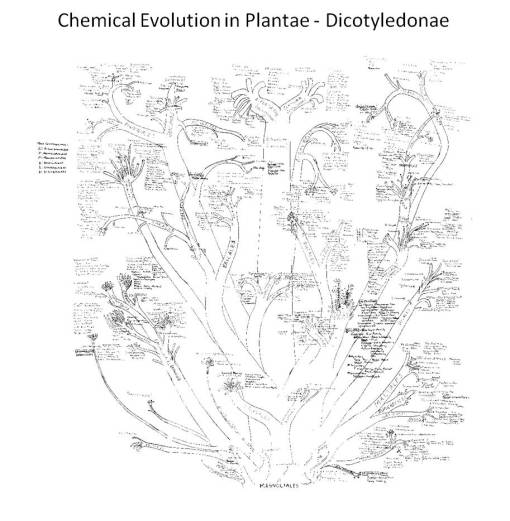
1988 lab notes on chemical evolution in dicots, based on Bessey, Dahlgren, Thorne and Hartshorne. Plant chemicals follow specific synthesis pathways, depicted in the above taxonomic tree.

.

The History of This Research.

As many of my friends know, I began my explorations of plant chemicals due to my interest in plant poisons. As a high school student, I taught various nature and conservation programs and gave edible wild plants and survival classes for the local Boy Scouts summer camp in middle New York. During this time, I accidentally ate a Swamp Iris rhizome in the early spring (April or early May of 1971 I believe, before the leaves were even a foot tall), thinking it was a cattail rhizome. An hour later I accidentally bit into the undercooked tuber of a Jack-in-the-Pulpit (Arisaema triphyllum) root, thus experiencing for the first time a strong burning pins-and-needles feeling in my mouth induced by the oxalate crystals that never dissolved during the boiling (the corm essentially was undercooked).

The next book I bought was Douglas Kingshorn’s Poisonous Plants, followed by several more on poisonous plants related topics including the then classic Mushroom Handbook published by Dover. (I often foraged for mushrooms as well.)

Two and a half years into my naturalist work with the local Boy Scouts, I spent some time working for the Clearwater Sloop organization, and then joined an ambulance corps and became an EMT about a year later. My interest then had turned mostly to toxic chemicals (pollution, industrial and household chemicals), drug abuse (heroin was the big one for the time), and poisons. After several months of ER work dealing with drug ODs, almost on a daily basis (with heroin and alcohol the main reasons), I was encouraged by the ambulance corps staff to consider going to college. A Vassar College student I had partnered up with for the EMT course was pre-med, and so recommended I consider the state university on Long Island for its sciences/pre-med program.

Upon entering the pre-med undergraduate program in biology at Stony Brook, I quickly got to know my roommate, a sophomore who specialized in neurophysiology. After discovering that my interests and knowledge were pretty much fixed on toxicology, he recommended I interview with professor he did research for, for a research assistantship position similar to his own. A week later, I was hired as a research assistant with a professor in the department who specialized in squid axon Sodium-Potassium channel physiology and biochemistry. Since I was also enrolled that same year in a course taught by Professor emeritus Adrien Albert of Australia, who specialized in selective toxicity, I immediately related his teachings to my interests in neurotoxicology and plant poisons and my research lab activities, and so the story goes . . . . The professor whose lab I did most of my squid axon research in shared this lab with Professor Jakob Schmidt, a specialist in receptor physiology as it pertains to Cone Snail Venom (famous for its highly selective, neuro-, cardio- and myotoxins). By the end of my second year in college, most of my research turned to research on the selectively toxic activities of tetrodotoxin, bufotoxin, triethanolamine, ouabain, strophanthin G, aconitine, various digitaloids, pilocarpine, physostigmine, purified enzymes extracted from snake venoms, etc., etc.. All of this just to better understand the physiology and mechanics of receptor binding on the neuron, by way of interpreting changes in membrane potential and the relationship of these findings to the Michaelis-Menten Na+-K+ channel model.
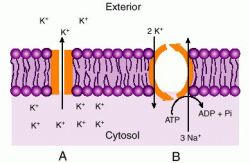
By the third year, had complete all of the undergrad neurophysiology work and was heavily into marine toxins (fish, shellfish, coelenterates, and nudibranchs), and so began frequenting the beaches and channels along the northern shores of Long Island. By now, my work as an EMT had evolved into a training officership position with the campus ambulance corps, and my specialty of course was poisoning and drug overdose emergencies. This obsession with plant and animal toxins led me to purchase Anthony Tu’s Venoms and the fairly hefty reference Poisoning.

This probably would have been the way my research and biology work went, had I not been given the opportunity to work as a naturalist and natural historian for the Museum of Long Island Natural Sciences located in the Earth and Space Sciences building at Stony Brook. This was originally done so I could qualify for a second undergraduate degree in Earth and Space Sciences (being the typical, competitive pre-med student that I was, of course), but quickly turned from an independent study program to a half to full-time botanist/naturalist position.

My work with this department began as the cataloguer of plants gathered in the past by the local naturalists, for the past 10 years. During this time I learned a great deal more about plant taxonomy, a local pine barrens ecology project and several environmental protection programs underway. These programs included a program vying for public recognition of the local endangered plant species Butterfly weed or Asclepias tuberosa, a plant covered in all basic biology classes which tells you about the monarch butterfly, which consumers the plant’s nectar, which contains cardioactive glycosides, that in turn cause any birds that eat the butterfly to subsequently vomit, and so save the species. This plant protection program rapidly became popularized by the news (there is even something in Newsday about me and a lady being told that she couldn’t run her lawnmower over the foliage, in order to protect the Butterfly weed growing in her yard).

I maintained my museum position as “herbarium director” from summer of 1979 on, during which time I developed some of my own collections pertaining to specific local plants of local ethnobotanical history importance, mushrooms (of course, I was into most of these due to their toxicity and the associated medicinal values), and produced numerous teaching specimens for the museum courses. In just a couple of months, this led the museum to make an offer to pay me for teaching outdoor classes on these topics, ranging from simple field trips through the local forests to actual accredited classes on teaching botany in the middle and high school science labs. Unexpectedly, these classes really took off, especially in herbal medicine, and subsequently landed me (and my students) a lot of time and airplay in the local and regional newspapers and interviewers. This, in turn, resulted in still more opportunities for me to teach these classes to local special interest programs and groups, and even spend some time with the local TV station.

In Fall of 1982, I began taking classes in medicine at the local medical school, interested primarily in plant toxicology and the potential use of selectively toxic plant chemicals as medicines. The politics of plants and medicine at that time was really problematic, and yet funny. The grandfather of medical history at the time was a professor from upstate NY who popularized the notion of quackery as it related to herbal medicine use. This prevented me from saying much about my opinions on their value as medicinal agents. Throughout my first two years there, still teaching on main campus, I would find that every now I’d be in the news and a few days later receive some anonymous letter in my medical school on-campus mail box criticising me for what I am promoting, and teaching on main campus. Even one or two very close friends kind of ridiculed the idea of researching medicinal plants, especially during my time as a medical student.

So how did I, as a medical student, get to research this topic back in the 1980s?

I managed to get some support doing this work by calling it a ‘history of medicine’ research project. Every summer, just before the academic year began, I wrote up a description of my research plan, as request by my mentor in the history of medicine. He would sign this proposal, allowing me to engage in regularly funded research on this project at the expense of the medical school’s internal grants and student financial assistance programs. During this time (lasting about 3 years), I specialized in Eclectic Medicine, since this field of study had the most scientific writings for the time (1825 to 1875) on plant medicines. I also researched a number of domestic recipes books, as well as the typical fields of alternative medicine (which the medical school of course had me refer to as “quackery”) including Thomsonianism (1812-1855, 1880s), Indian Root Doctoring (1780s to 1840s, for the most part) and Homeopathy (1823 on, 1837 on for NYC). It was also during this time that I began to decipher and translate a vade mecum (recipe book) penned by a colonial doctor in upstate New York, making use of the local plants.

During the next several years, I attended annual meetings of medical historians in New York’s Medical history library (once part of one of NY’s earliest medical schools). There, we members of the historical society would argue about the most important topics for the time. These historians were from the various mid-Atlantic and New England medical schools, and most were classical sociological medical historians for the most part. Their mentor pretty much kept popular his viewpoints on Quackery, left for him by an earlier AMA member and representative in charge of eliminating quackery from this field of practice, Morris Fishbein. Few had an interest on whether or not the herbal medicines of the past worked.

Also during these years, I made attempts every semester to enroll in a PhD program devoted to researching plant toxins for potential drug uses. The pharmacological sciences program affiliated with the medical school would regularly interview its candidates for this position, and I would apply every year. Each year, I’d go to the department’s for prospective students, hoping to find the mentor, grant money and professional support needed to engage in work much like what I had already done in the undergraduate neurotoxicology labs (one of these professors was even in the same department and building I worked in).

At the time, the politics of plant medicine made it difficult for me to obtain full department support for this type of work. And since the university had just been rewarded a multi-million dollar grant designed to bring to market the first immune system medicines to the industry–interferon–I was constantly reminded of this with each year’s discussion of my research interests with the pharmacology department staff, and by the pretty personal notes left in my mailbox each time I was in a local newspaper for my courses on plant medicine and edible wild plants.

The one topic I did obtain substantial support for at this time, but did not get into a PhD program for, was the development of a database (on a Wordstar/Datastar, Sanyo 550) useful for diagnosing plant and mushroom toxicology. A database with this information was already in place, on microcards and microfiche, but not in any computer-related database-query form. So, this first attempt to produce a computer-generated diagnostics tool useful for identifying plant poisoning cases based on symptomatology was initiated, with the limited support of two local experts in toxicology emergencies. To produce this database, I had to purchase the most up to date PC with CPM/SYS as its basic programming language form, a 2kb + 2kb hardrive, and the software needed to develop this database/diagnostics program-Datastar. I used the term “toxidrome” to define this program (it was called Toxidrom, 8 characters), because it was used to describe dozens of toxic syndromes associated with domestic and wild plant ingestion. As an aside to this small-local-grant-supported work, I also used the same software to develop an herbal medicine database, of course focusing on “quackery” and herbal medicine toxicity of these products, but also their history and use.
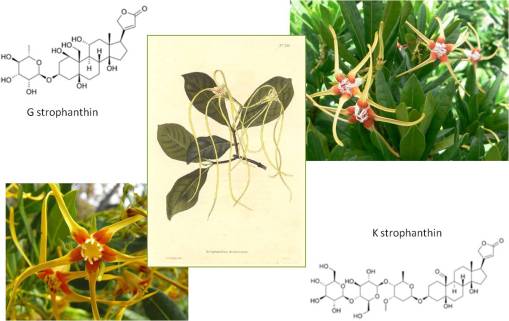
Interestingly, throughout this time researching the history of plant use in medicine, I knew my topic of interest was not dead. Each year, whenever it was time to apply for the MD-PhD, the pharmacology department head would meet with me, very cordially, because he was interested in updating himself on what I knew about plant drug compounds. We had discussed a number of projects that needed to be done in his lab, for example using the cardiotoxin strophanthin G and its derivatives to study membrane channel receptors, and we rediscussed the potential for researching several new neurotoxins, and more specifically the possibility of researching the rapidly growing cancer drug industry that existed for epipodophyllotoxin (today known as etoposide)–at the time I was researching other plants that I knew produced this drug locally (in particular, Podophyllum peltatum, the same plant used to make the Carter’s Little Liver Pills above), and had a few other plants with pharmacological industry potential which were of potential use as intercalating compounds for the treatment of the most active forms of cancer (esp. testicular cancer).
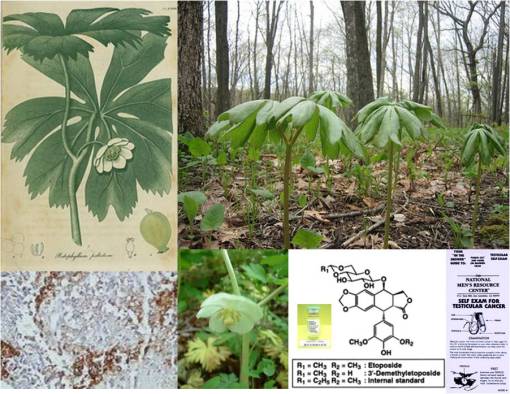
In 1983 and 1984, a number of people saw some shows that were aired about me on the local TV channels–apparently these shows were being aired in the hotels and motels in New York City. This led me to make contact with a pharmaceutical company, that paid me a lot for my time, to serve as a consultant in the field for a year (each Wednesday they would pick me up in a limo outside the front of the University Hospital). It also led a PR person from the only fully accredited west coast school at the time on alternative medicine to offer me a teaching and research position once I graduated.

The following year, during a trip out west (a follow-up on an offer due to another offer related to a TV clip shown on TV), I saw another cancer drug source being burned as a consequence of the slash-and-burn clearing methods employed to this region for its lumber-producing trees. The local Yew Tree, a source for the cancer drug taxol, was the fuel for most of the bonfires that I witnessed. I next contacted some associates on the east coast and talked with a number of people in the university, television and local news agency settings about this.
Three cancer drug producers in Oregon’s Old Growth Forests

This led me to compose a research proposal and presentation on the natural resources of that region applicable to the pharmaceutical industry. In January 1987, I was fortunate enough to be asked to discuss this issue on a local TV news show, as an expert in plant products along with many other natural resource experts; I mentioned the potential cancer drug-producer locally of taxol and the rapidly growing LEAR Oil industry about to take hold (low erucic-acid rapeseed oil, later known as Canola Oil, a bioengineered plant products food industry). Also present were a number of local graduate school professors interested in bioengineering at the time, only they had an interest in just making pulp for paper and saw no value in trying to bioengineer medicinal products, an accomplishment still years away from accomplishments they reckoned.

I could tell from these meetings that both the local scientists in bioengineering and the local forestry service workers were very poorly trained in the complete use of natural resources as sources for secondary products. Still, my exposure through this program was good for me. Soonafter, I was asked to give a similar talk to the Geography department at a local university, and so in February 1987, I discussed the potential applications of the new natural products industries to the diminishing local forestry industry. This work included my review of the importance of plant- and mushroom-derived products obtainable locally, as adjuncts to the local cottage and forestry-related industries, and the possible development of programs designed to make the best use of the local flora for phytochemical products. At this talk, I also defined the three cancer drugs native to Pacific Northwest forests: Libocedrus-epipodophyllotoxin, Thalictrum-thalictrine and derivatives , and Taxus-taxol and derivatives. (One of the foresters there, who followed up on this suggestion, later thanked me for this information and its ultimate success in the local cottage industries program just started.)

By the end of this talk on Pacific Northwest natural products, I was offered a lab to research plant chemicals in by the chemistry department, and was told that I could pretty much perform my own research, at my own speed and pace, in my own areas of interest, at the department’s cost for chemical supplies. Within a month, I set up a lab and was soonafter asked to write up a proposal on a course entitled “Chemical in Plants”.

.
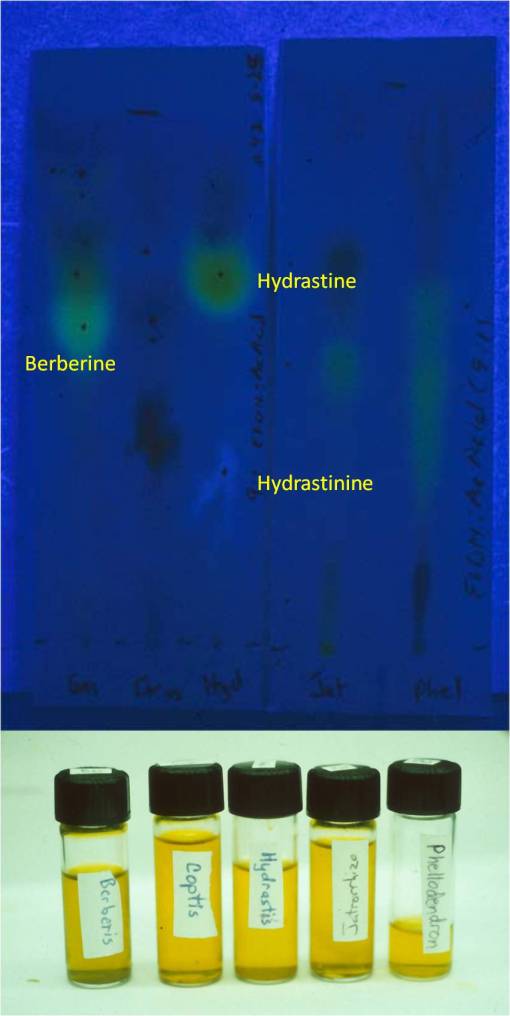
Thin Layer Chromatography results for one of my studies, 1987-9. Note hydrastine to hydrastinine conversion in Goldenseal, due to short shelf life as a powder (approximate shelf life, 3 mos., including packaging and storage). This converts Hydrastis from an antibiotic, a common claim for the hydrastine in it, to a smooth muscle relaxant due to the hydrastinine.

For the next 17 years I taught this course and its various modifications devoted to plant tissue culturing, bioengineering, chemotaxonomy, tropical and northwestern rain forest products, Oregon history natural products, etc., and I used this lab to study my various groups of plant chemicals, in particular those that were selective toxins. I was particularly interested in alkaloids, but not the commonly known neuro- and myo(myelo)toxic varieties any more, but rather the benzylisoquinoline alkaloids–which contained several types of cancer drugs in need of further investigation and testing for clinical use in treating the toughest forms of cancer cases. I also took this opportunity to once again spend time investigating podophyllin-like neolignans in plants such as the local Mayapple (Podophyllum) relatives Vancouveria hexandra and Vanilla Leaf (Achlys triphylla). I worked out the mechanism by which Achlys was producing coumarin mostly after it was detached from its rhizome. I documented the overharvesting of the local ginseng-substitute Oplopanax (Devil’s Club) by local cottage industries devoted to herbalism (this was during the spotted owl years and news episodes.) When I was asked to present at an annual meeting held by local wildcrafters, I developed a list of about 50 underappreciated local natural products that were out there, as defined by their chemical and non-chemical uses. I presented these results at an annual meeting of harvesting companies held at the state Capitol building in winter of 1990/1. A new program was then developed requiring harvesters to register for and obtain harvesting permits for old growth forest plants in order to prevent overharvesting.
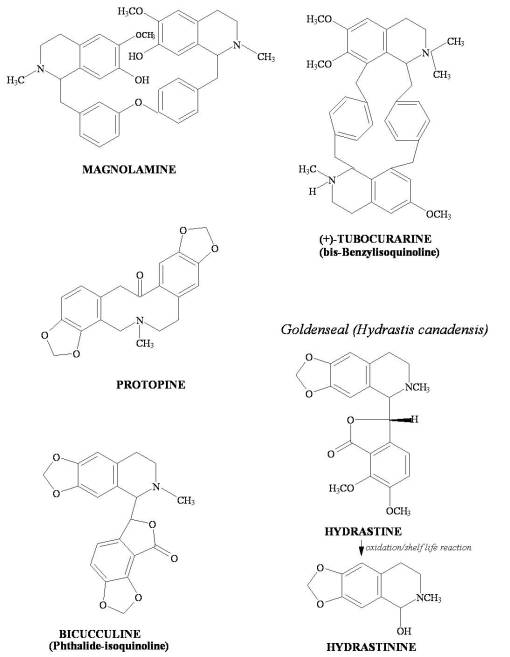
Common Benzylisoquinoline alkaloids and allies in herbal medicine

Over the the next decade, I researched sesquiterpene lactone toxicity and the curious case of lumberman’s lung disease brought about my it, essential oil-, iridoid- and flavonoid-chemistry and taxonomy, the taxonomy, evolution and development/synthesis of seed oils, triterpenoid chemistry and evolution, latex products and chemistry (esp. sapota and its chewing gum), northwest and western Native American ethnobotany, the history and development of the naturopathic medicine program and field of study in Oregon, Oriental Medicine, the history of plant use in treating ophthalmologic diseases, Overland (Oregon) Trail “alternative” and herbal medicine, and the chemistry and use of bioengineered products from plants. My short term projects included the development of an updated version of my herbal medicine toxicology database (still in use by an Alternative/Herbal Medicine software program (once again employing the Toxidrome teachings of Howard Mofenson of Long Island, 1980-1990), the investigation of several intoxication cases related to over-the-counter herbal products (adulteration by look-alikes or mistaken identities), research into the local glycyrrhizinate-induced endocrine-like dysfunction cases related to extensive herbal medicine use, the investigation of the tryptophan used by one of three of the first local cases (the result of unmonitored, uncontrolled microbial bioengineering of an OTC by an non-American industry), the study of mushroom grower’s lung disease pertaining to a local Shitake industry, the identification of plants associated with southern Oregon Klamath encampment and a New Mexico ancient tribal settlement, the “chemistry” and geography of local wildfires (i.e. the reasons for the Tillamook burns), and the design and development of a ethnobotany masters program at a local college.

.
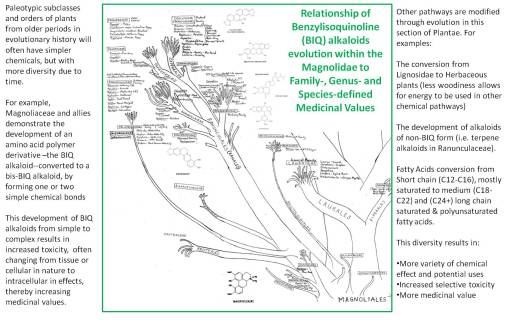
In 1987, my lab work on alkaloids, lignans/lignins, simple and complex tannins, flavonoids, seed oils, and coumarins (many Berberidaceae compounds) led me to construct my first extensive chart depicting the evolution of these products in the Plant and Algal Kingdoms, beginning with the “Ranales”, Magnoliidae and certain Rosidae and Dilleniidae herbal medicines with benzylisoquinolines, followed by the rest of the tree over the next few weeks. After three years of alkaloid research, along with teaching the course Chemical In Plants since 1989, I finalized my first written work on this topic in 1992, along with my version of the plant evolution (and chemotaxonomy, natural products, and chemistry) tree, which was subsequently used as top teach my courses given at the university for the next fifteen years (I updated this writing in 2003, copies of which are still found every now and then, and once again, this Evolution of Natural Products/Evolution of Chemicals in Plants book is once again being updated, and given the new technology, more than adequately illustrated. My focus on the evolution of chemicals in plants pretty much pertains to this part of my academic and research history.)

The Evolution of Plant Chemicals

There are reasons plants bear chemicals of medicinal value. These reasons are not as simple as stating there is some sort of combined natural and social darwinian evolution taking place. This argument is very tempting due to its relationship to the highly popular Gaia hypothesis, but it is somewhat an incomplete picture of the phytochemical synthesis process.

It is best to consider the possibility that there are a number of reasons why plants develop their complex chemistries, reasons that typically have nothing to do with human ecology and the plant. Plants chemicals are traditionally referred to as primary and secondary natural products. The primary products are those essential to the plant living processes, and the secondary products are all those other chemicals plants produce which provide them with additional survival benefits.

To date, the medicinal plant chemist has been quite content with interpreting plant chemicals as primary and secondary products. Whereas many biologists and plant physiologists have become experts in much of the primary metabolic chemical processes (all that stuff we learned in biology, biochemistry, molecular genetics, and physiology classes like the Krebs Cycle, gluconeogenesis, DNA replication, protein synthesis, photosynthesis, the C5 pathway, ad nauseum), and some of the common secondary products such as auxins, gibberellins, xanthophylls, and anthocyanins, to date it has been difficult to accomplish the same with secondary metabolites in plants. Referring to these pathways as secondary metabolites was too simplified for a fairly lengthy and rather complex biological process inherent to all plants.
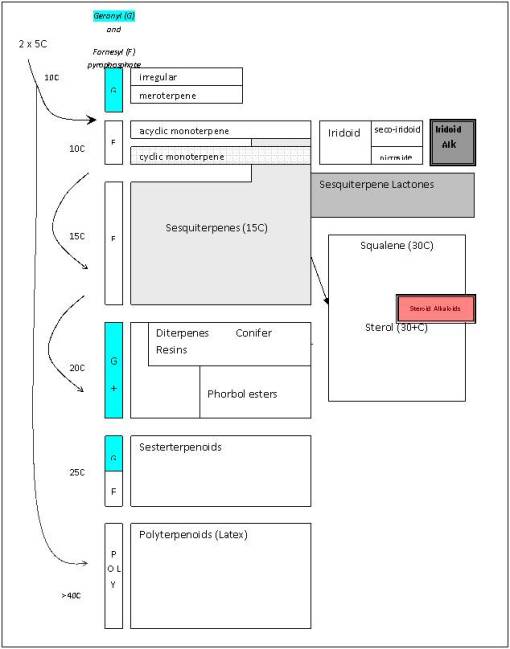
Isoprene/polyterpene paths

In fact, the secondary natural product paths in plants themselves can be broken down in some sort of hierarchical, evolution-derived series of steps taken by plants and their consequences ecologically in terms of survival. This led me to develop a method for analyzing plant evolution, based on levels of importance to plant survival and existence. For example, one way to consider primary metabolites is as a biological “soup” of materials, and the first level of synthesis in plant chemistry as a result of environmental stress, without regard to human involvement–this level of evolution results in the production of chemicals that involve plant to environment interactions or what I call the “environmental soup”. The third level is the ecological level of interaction between plants and other things–these things are biological, and their resulting role is more ecological in nature, I termed this the “ecological soup” of plant chemicals. The final relationship between plant chemicals and other entities in the “anthropological soup” or human nature of plant interaction with their environment. All of these “soups” play important roles in the evolution of plant chemicals. These primary, secondary, tertiary and quaternary levels may be defined chemically as follows:
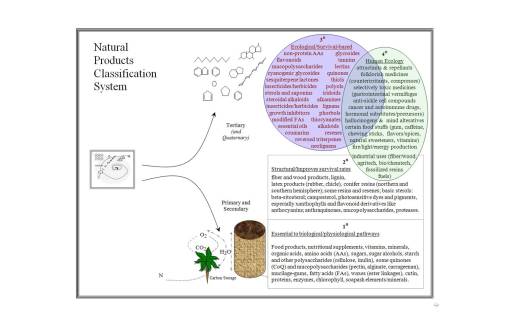
The best way to review secondary natural products in plants is to view their development at three levels.

Level 1 products synthesized by plants provide them with an edge when it comes to surviving in their natural setting; these products are the result of massive amount of energy spent producing chemicals that give plants an edge on their closest relatives, or neighbors of their own kind, and are for the most part adaptive to the environment and meant to deal almost completely with environmental features. These are mostly the biological and environmental “soup” products detailed above. Examples of these types of products are wood and fiber chemical groups and the pathways merged to form these entities. They provide protection, enable plants to grow at taller heights, and are usually the result of the plant either slightly modifying or making much larger amounts of substances already produced by their metabolism. When a polysaccharide pathway changes its emphasis from simple starch to mucopolysaccharides, for example, in order to improve water retention in droughtish environments, this is a level 1 secondary metabolite process. When a plant seed oil evolves from small molecular (short chain) form to medium and large (long chain) forms, this is done as a consequence of survival in much colder environments, where short chain fatty acids provide less bioenergy storage, that behaves more like a solid in cold climates, in places where more of this energy has to be stored and has to be more stably transported during the colder times.

The following is the sequence in oil chemical complexity.
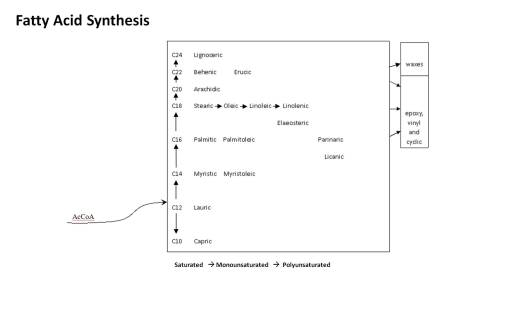
I put a lot of these products at Level 1 because they are essentially common sense in nature. The length of the carbon chain in the fatty acid and the numbers of double and triple bonds is what tells us how evolved the chemical is. Fatty acids tend to evolve from C-12 to longer chains by adding 2-carbon blocks. The early evolved tropical paleoflora (Magnoliidae-Lignosae) predominantly have short chain fatty acids (C12-16) that are saturated. Energy is spent by the plant to make these longer and to produce their double bonds. Those which develop double bonds are more complex. Those which are longer are more complex in an evolutionary sense. Those with very long chains are the most evolved, and often are associated with other species in the family that have other advanced features such a triple bond formation (vinyl fatty acids) and very long chain fatty acids (C20+), for example Asteraceae members and allies. The tropical habitat is often replaced with colder and colder climates as part of this process. Plants adapted to very cold settings produce longer fatty acids with multiple double bonds in order to produce a more stable oil for the temperature changes related to that living environment. Plants heavily adapted at a Level 2 (Tertiary products level) with fatty acids produce fatty acids that serve an ecological-survival purpose, such as the strongly antimicrobial, antifungal gorlic, chaulmoogric and hydnocarpic fatty acids of the Flaucortiaceae (see below). Asteridae members produce cyclic modifications of fatty acids for special needs, i.e. Vernolic Acid.
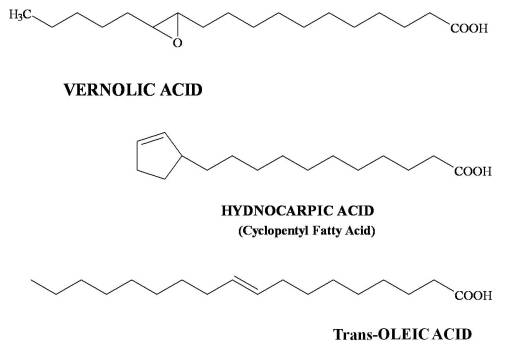
Level 2 secondary natural products are those that plants produce in order to serve some ecological purpose. These chemicals are produced and directed at other organisms, be they plants or animals. They range from the sesquiterpene lactones and allies developed in some desert plants (used to prevent competitors from thriving in the soil beneath them), to the change in chemistry of a simple sterol making it an effective feeding deterrent effective against slugs and other small herbivores. Flavonoids are a good example of this because for the most part they serve ecological purposes in a plant. There are a few of these that are Level 3 in nature, but for the most part the plant has survived with flavonoids due to their value as petal color-related attractants, as secondary photosynthetic pigments, and in some cases as protectants (rotenoids).

Level 3 secondary natural products are really those which have uses that are invented by man. The chemicals already exist in plants and are probably there for a Level 1 or Level 2 purpose, but this purpose may be related to, or distinctly different from the Level 3 purpose assigned to that chemical evolution by people. The most common examples of these are flavonoids people often cherish as medicinal. The plant doesn’t benefit from reduction in hypertension, for example Hawthorn berry, but certainly man does. The clearest example of an anthropomorphically redefined phytochemical use involves the anticancer drug, which rarely affects animals as much as it benefits man. The epipodophyllotoxin of Libocedrus bark in an ecologic sense is perhaps antifungal, antiviral in nature and therefore protective. To people however it has a toxic effect on cell division and is deadly to mitotic cells, a feature all cells must express to survive, but one that is expressed more frequently by dividing cancer cells making them more susceptible to this form of toxicity.

This method of interpreting plants chemicals give us a better understanding of these natural products and allows for a more comprehensive approach to be taken for understanding how these chemicals in nature and in the presence of different human cultural settings. Once plant chemicals become an important part of human ecology, the long-term impacts of this on the plant species changes. take for example the Level 2 toxins possibly developed to prevent insect and other forms of feeding. These neurotoxic compounds, like nicotine, ephedrine (in Mormon Tea), and perhaps even some of the mood alteratives and hallucinogens like caffeine and mescaline, play one role in nature, and another in the human ecologic setting. Applying this to the seed oil, we see the evolution of short to long chain fatty acids occuring as a consequence of environment, followed by the conversion of these long chain fatty acids into more complex cyclic fatty acids like the chaulmoogric and gorlic acid typical to Flaucortiaceae plants, a substance toxic to certain seed eaters, and important to human health and skin. The erucic fatty found in Cruciferae is non-edible (and toxic) to people, but highly important in industry as a fuel and lubricant oil used in aeronautics; with bioengineering, we modified the oil by reducing significantly this toxic components, resulting in one of the more popular “healthy” cooking oils Canola/TM. As Level 3 compounds, these chemicals, further improve the plant’s chances for survival ecologically, by taking advantage of the much larger human ecology setting; we take advantage of the fact that the plant produces these oils and so make them an important part of our hygienic and medical practices and our various chemical industries.

All plant chemicals have a reason for forming. Scientists once liked to state that the production of secondary compounds was merely a consequence of plants overproducing too many by-products as a consequence of their primary metabolic pathways. The plants had to do something with all those chemical products they produce–why not just assume that plants convert these chemicals into other things, by chance? and if these changes are to their benefit, these plants will just be selected for by nature.

The human experience with plant chemicals provides a very different take on this same situation. Why not allow human ecology to be one of the main reasons plants produce compounds by way of the natural selection process?

In some cases, plants are medicinal due to their natural protective mechanisms, and others some combination of medical and toxicological features. For example when the strongly insecticidal compound nicotine is developed by a plant in order to serve as a natural insecticide. This ecologically-driven reason for nicotine production later gave way to an unanticipated application of nicotine to the human experience. This same argument can be made for the numerous hallucinogens and mood alteratives noted in plants, the various chemicals we have come to appreciate for their utilitarian benefits such as fibers and dyes, and the ultimate end products that come to be following a significant modification of common plant chemicals such as starch, seed oil, latex and cellulose.

Although many plant chemicals in fact have little evidence demonstrating natural ecological reasons for their development, in most cases, there is a reason, only we have not found it. The human experience with plant chemicals and medicines is also an evolution-based production process that a plant engages in; it requires some sort of intervention by man. Other times this unique feature of the plant is due just to the human experience attached to the discovery of that product. It exists regardless of whether or not we intentionally make use of this chemical product. This latter form of evolution of plant use is more an example of culturally-defined evolution of a plant substance than a simply complex example of some natural form of phytochemical evolution we have yet to attach any scientific reasoning for. People appreciate a plant substance for their interpretation of the value of this chemical or chemical-related end product. This often plays the most important role in determining the ultimate value of a plant to a given group of people or sociocultural setting.
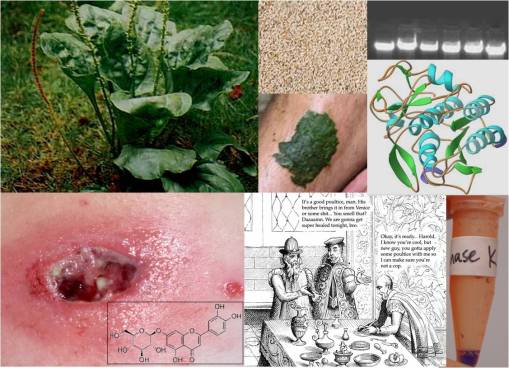
Transformation of Common Belief. Significant portions of what we learn in medicine are very much derived from personal and professional belief systems. The philosophy of science is medicine’s religion. Not that science is a bunch of questionably misleading human-defined relationships. There is some value to science and its observations and hypotheses. These help to define the next trail we may perhaps take in our professional career. Philosophy is after all why echinacea is considered an excellent immune agent, right? Those who answer ‘no’ to this usually base their argument for such a claim on the synthesis of data in a laboratory. But the reason the lab experts took on this experimental role in the first place is primarily based on facts produced much earlier when the true plant with this medical use almost went extinct, due to its overharvesting around 1850–the Ratibada of the Great Plains It took a well-disciplined eclectic medicine trained chemist in the early 1900s to prove that Echinacea could perhaps have similar attributes. Which he accomplished, leading to the use of echinacea as the next generation of Ratibada substitutes. It was then up to later herbalists, scientists and doctors to re-explore these early studies, and with the help of money and Occam’s razor, begin their own personal search for “Truth”, a very based way to begin such a study.

Now, a lot of herbalists and plant chemists are not going to like this line of reasoning. It is not intended to say that the study of plant chemistry and medicine has to come to a halt. It is to instead tell readers that the more complex our knowledge is about science and the microcosm or subcellular cosmos, the more likely it is that we can come up with a theory that pleases us about the use s for a particular plant. After all, I spent nearly two decades focused on benzylisoquinoline alkaloids, sesquiterpene lactones, iridoids, fatty acids, colorants, and cancer drugs in the lab. Instead, this is meant to suggest that the history of a claim be fully explored before spending a lot of time and money studying something based on a totally different perspective or philosophy upon which you base your scientific reasoning.

In many cases, new medical treatments are found because they fit a model that is already out there. Instead of allowing some reasonable method of evaluation to guide one to the right compounds foe the cure, we have preconceived notion of what type of chemical group could be something like a cancer remedy. This preconceived notion guides us to find the evidence for an antimitotic we were looking for, or some sort of lectin, or some sort of brand new groups of chemicals in the popular culture of herbal medicine chemistry–the iridoid. Medical botany teachings can be traced from one generation to the next and the philosophy underlying the reasons for effectiveness also traced and its own cultural constructs defined in terms of the period of medical tradition under review. This is not only true for historical botanical medicine, but also many aspects of modern pharmacognosy and contemporary medicine in both the regular and alternative medical worlds. This point of view of medicine places greater emphasis on the mind-body healing processes and any important roles these may play in assisting regular and alternative healers.
 

My favorite example that I give of this in class is Erasmus’s tale of the Plantain and the Toad, in which the Toad confronts a spider, is bitten on the back and so retreats under the local Plantain leaf. Resting there for a moment, the toad bites the plantain leaf because he/she couldn’t bite the spider. Later, the toad confronts the spider once again and wins the battle.

To Erasmus, this was a folktale of a symbolic nature meant to be retold. So, in the beginning, Erasmus’s story was retold numerous times, in the meanwhile never really being interpreted as having anything to do with medicine and healing. Then one day a herbalist catches wind of this story and slants it is a new direction. The next time this story is retold, the plantain is referred to more as a medicine than any sort of plant cover for the toad. Next this herbalist adds that, somehow, by being in contact with the leaf on its back, the plant was able to heal the swollen spider bite.

The next time this new version story is retold, it is not just the bite that can be healed with plantain, it is also any kind of swollen tissue. A time or two later this swelling is likened to an abscess, “tumor”, canker or “cancer”, and soon after, with the differences between canker, “cancer” and true cancer not at all well delineated, the plant becomes a “cancer cure”. The result is this Plantain leaf is now being applied as a mash to the surface of skin with a cancer (even though the skin problem was simply a swollen abscess misinterpreted as cancer). Miraculously, this “cancer” goes away, and a new cure for “cancer” is born (the time is now ca 1795-1810). However, during this time there was no way to differentiate true cancer from other “tumors” and “cancers”. And so this legend continues, each time slightly rewritten and paraphrased to best fit the expectations of a writer for the time claiming this to be a “cancer cure “. For example, consider the following case reports from the Botanico-Medical Recorder, Ohio, 1834. It involves the use of a Thomsonian remedy to effectively get rid of “cancer”:

The result of this Thomsonian remedy is obvious: the acidic sorrel ate away at the “cancer”, as it would any wart, abscess, boil, canker, or surface of a “tumor”.

Between 1820 and 1850 (i.e. Wooster Beach and Elias Smith), this story-telling finally hits a number of highly popular medical books, for both regular and reformed medicine. This retelling of the cancer cure story continues into the 1860s when cancer is finally starting to be better understood microscopically and physiologically. Yet the true cure for cancer remains totally misunderstood.

While domestic medicine books are continuing to tout such cancer cures as sorrel, rhubarb and other acidic plants capable of blistering and eroding away flesh more than cure any specific medical problem, the authors of professional writings were beginning to know in better detail the physiological and biological differences between cancer and “cancer” as the public understood it to be. There was however no understanding of cancer as a consequence of cell division. It was still being interpreted as a reaction to various environmental stressors, consisting of what had come to be better understood as an inflammatory response. This complete disconnect between physicians and the general public allowed the discovery of new cancer cures to be founded by a number of popular culture herbalists, gifted healers, and need I say, charlatans in some cases. A good example of this is the founder or renunciator the old-time German born “Essaic” cure (Germans invented it, a nun promoted it: sheep’s sorrel, burdock, slippery elm and turkish rhubarb; read more at Suite101: The Essiac Cure for Cancer http://www.suite101.com/content/the-essiac-cure-for-cancer-pt-1-a261150#ixzz1BNwRmyKy).

About this same time, there was a true cure for cancer already in use out there by many people–podophyllum resin–but that was only being used to treat the liver (Carter’s Little Liver Pills), not the canker or tumor. The true cancer use for the Liver Pills remedy was never known until the mid-1900s, once the mechanisms of DNA and cell division became known It is now the top testicular cancer treatment and is in the small cell lung carcinoma regimen. It wasn’t until we knew what cancer truly was, enough to distinguish it from its similars, that the true cure for cancer could be found.

Continuing with the plantago part of this story, a couple of years ago some scientists who are experts in chemistry finally hear about this miraculous cancer cure Plantago, and without ever double checking the original sources, jump in and initiate some sophisticated chemical and biochemical analyses. Lo-and-behold they find something that could be curing the “cancer” after all–one says it is a flavonoid, another claims it to be an iridoid, the third individual a Proteinase enzyme. Either could be right with what they stated–if the plantain worked and was originally used to treat a cancer on the toad’s back. But it wasn’t.

The result of this type of query by scientists is what has come to be knnown as the Occam’s razor effect. They both got the results they were hoping to get, without concern for re-evaluating the origins of this tale once the discovery is made and published. Since the common belief is there, it had to be true . Since it is a very old tale, that was told and retold, they wonder-how could it possibly be wrong?

Now, plantain is by no means the only example of occam’s razor in plant chemistry and medicine. Transformation of common belief (TOCB) is what makes plant medicine what it is today. Very few of the current claims about plant medicines have both experiential and scientific validity.

The first examples I uncovered of this phenomenon in plant medicine history related to the Native American snakebite cures common to early American medicine. This is such a common philosophy in medicine that in the mid-1990s I began exploring its origins. I found evidence for this philosophy in the earliest colonial and exploration writings, and in the Oregon Trail writings I had commenced in 1993. I also noticed that there was some changes in the wording about the uses of these drugs by herbalists, to keep up with the industry for the times. By doing so, they transformed the remedy and how it works from one condition to another. For example, the snakeroot used to treat convulsions induced by snakebites might be turned into a seizure remedy (Scutellaria), another snakeroot was transformed from a remedy used to treat muscular pain induced by venom to a remedy used to calm uterine smooth muscle contractions (menstrual pains) (Caulophyllum). Since skeletal muscle and smooth muscle are totally different in their pharmacology, I realized there was something interesting going on here. People redefined a herb’s use and then tested it, believing in their own claims, they increased the likelihood that they would meet their own expectations and produce the outcomes they needed.
Now, when science looks back at many of these uses, scientists accomplish this according to their standards and little more. With herbal medicine, there are numerous interpretations about medicinal plant use which we are informed of by historians, anthropologists, herbalists, botanists, chemists, pharmacologists, physicians, naturopaths. This is much like the blind man describing the elephant story of Buddhist canon Udana 68-69:

“”Thereupon the men who were presented with the head answered, ‘Sire, an elephant is like a pot.’ And the men who had observed the ear replied, ‘An elephant is like a winnowing basket.’ Those who had been presented with a tusk said it was a ploughshare. Those who knew only the trunk said it was a plough; others said the body was a grainery; the foot, a pillar; the back, a mortar; the tail, a pestle, the tuft of the tail, a brush.”

Or better yet, retold as:

“Thereupon the men who were presented with the first chemical separation answered, ‘Sire, the cancer remedy is a cellulose fiber.’ And the men who had observed the second separation replied, ‘Ah, the cancer remedy is like a polysaccharide muciloid.’ Those who had been presented with the third extraction said it was the pigment chlorophyll. Those who knew only the fourth said it was a phytosterol; others with separate extractions said the cancer drug was an alkaloid hard to separate out, yet another the iridoid aucubin, and for others: a tannin, the leaf’s wax cutin, an immunogenic complex polysaccharide found just in the mesophyll, an unusual lectin contained by just a few cells, and finally the enzyme protease. Ad nauseum.

http://en.wikipedia.org/wiki/Blind_men_and_an_elephant
The lesson here: Occam’s razor brings forth the cure.

A chemist can look at any plant and have so many different types of chemicals to be found and classified, that one of these could be the real thing, or not. It depends upon what we want to believe. To one physicist, light is a wave, to another in the same lab on the same, just a few seconds later, that same light is a particle (the wave-particle duality theory, see http://en.wikipedia.org/wiki/Wave%E2%80%93particle_duality). To one scientist, this was a matter of fact, to another, the results of an individual’s perception of things.

ENVIRONMENTAL RESEARCH – PART 2 — GEOGRAPHIC INFORMATION SYSTEMS

Three things led me to my work as an epidemiologist from 2000 on. I began to map plant distributions to document the relationships between different natural product types around the world. These relationships were in part due to the massive shifts of continents that took place due to the tectonic plates history of the earth. I used this to better understand how oils were evolved relative to climate patterns and latitudinal orientation of the major plant groups. This also helped define how and when certain chemical compounds became an advantage to their survival, such as the evolution of steroids and saponins due to their anti-feedant effects upon invertebrates with moist skin (worms and snails). The reasons for the early evolution of toxic amino acid by-products such as nicotine and ephedrine were obvious in terms of plant evolution. The same could be said for the reasons plants developed such things as tannins, polyphenolics and lignins.

I next began to develop a way to map out the distributions of medicinal plants in general, more for teaching reasons, and digitized a version of my chemotaxonomy tree for use in ArcView GIS fairly early in my years using this software. At some point, while plotting out Great Plains flora, I came upon repeated articles mentioning the uses of plants along the trail for medicines. Often times, the primary disease was “cholera.” When I noticed that a number of dysentery epidemics were mistaken as asiatic cholera from Wyoming westward, I decided to research this topic and determine a way to identify that mysterious form of diarrhea hitting the overlanders. And so my more serious work with GIS and remote sensing began.
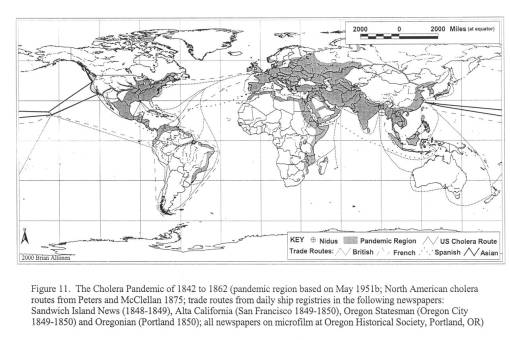
Cholera on the Oregon trail, 1849 – 1854.
For my first graduate degree, an MS in Geography, my thesis was informally known as the “geography of diarrhea.” More professionally stated, my work for the thesis focused on the various environmental human features responsible for two epidemics that struck the Oregon Trail between 1849 and 1854. These epidemics were pretty much a recurring feature in Oregon Trail history, with some years worse than others.
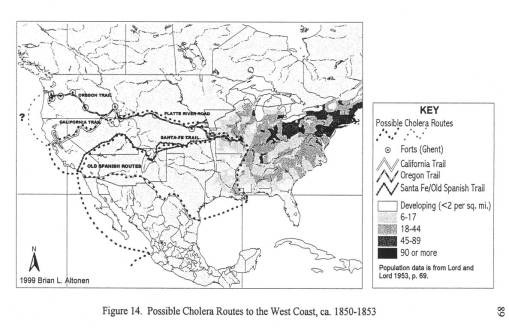
The first epidemic of diarrhea in eastern Nebraska was due to recently slaughtered Bison found near an Pawnee Indian camp. Local history tells us that these 1845 to 1847 notes of “cholera” were closely associated with the dead Bison seen as the Platte River bends southward along the trail and the emigrants travelled westward. These dead bison were due mostly to a recent uprise that had taken place between local Sioux and Pawnee indians disputing this territory. By passing these carcasses, travellers commonly suffered a severe spell of diarrhea, which they attributed to the bad water and the bad meat they obtained by hunting in this region.

The second much larger epidemic of diarrhea in Nebraska was due to the Asiatic Cholera global epidemic striking the midwest. This epidemic made its way inland from New Orleans to St. Louis to Fort Kearney, between March or April of 1849 and July of 1849. Travelling to and from the fort was done by water, land and foot. Most likely, it was the occasional supply ships that first brought this form of cholera to the Fort, followed by individuals infected at their jump-off towns and in St. Louis during the later months and years.

The third diarrhea epidemic, akin to the first, resurfaced in eastern Oregon around mid-summer 1852 and finally hit Portland by January of 1853. This epidemic was due to an outbreak of an opportunistic form of dysentery caused most likely by the Salmonella intermedia released by decaying animal flesh lying between Wyoming and the Idaho-Oregon border. Although other bacteria may be associated with decaying animal flesh, the most ubiquitous bacterium with the best ability to produce the “western cholera” as it was descibed in the diaries, was this particular type of salmonella.
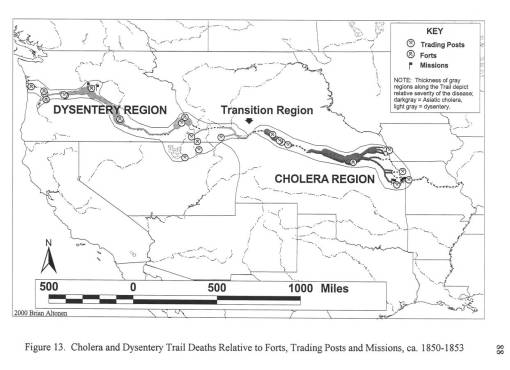
By mapping each of these epidemics, it was demonstrated that human population features were responsible for the asiatic cholera suffered during the first few days of travel along the trail; this epidemic was often fatal. The pre-1849 outbreaks and the second set of 1849 to 1854 outbreaks of diarrhea were due to dead animals. In particular, durign the years of heavy migration (1851 to 1853), we find the effects of animal carcasses on overlanders beginning to reach their peak. The most likely cause for these animal deaths, namely oxen, during these migrations was the topography of the region and constant, recurring and tiring elevation changes. Due to this part of the migration, one physician noted passing hundred of carcasses per day in Wyoming, mostly in the foot hills region of this part of the migration. From central Wyoming westward, the most common causes for diarrhea remained exposure to these dead animals.
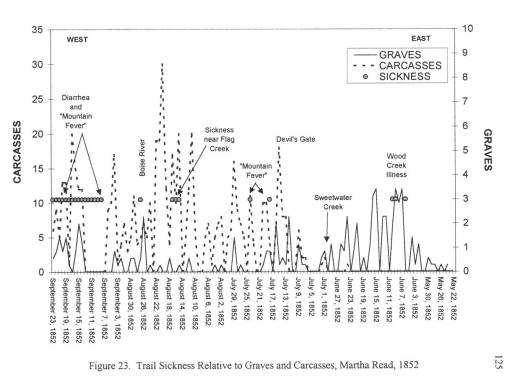
Important climate data was obtained from Fort records for this time, since weather records had to be kept for health-related purposes by all government operated military forts. The best elevation-temperature data on travelling the trail came from explorer and government official John Fremont, who travelled through this region in 1852 and 1853; he kept temperature, weather, and barometric pressure records which were taken several times per day. Due to the details of his record keeping in the journal, his entire travel route and places of encampment could be mapped. Much the same could be said for another official travelling to Oregon in 1845, whose diaries also made important notes on the local ecology, geology and water-related features.
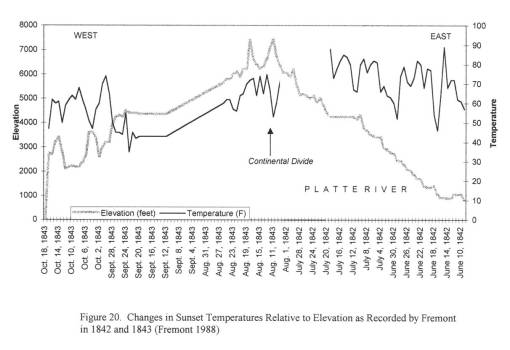
The best insights into these two diarrhea epidemics came from the trail diaries many people kept, especially those written by physicians or scientists, and women trained in the new field of medicine known as hydropathy. The physicians kept daily weather logs and medical notes on their excursions. Hydropaths kept track of the weather, the number of dead horses and oxen passed each day, water sanitation, diet/food behaviors, and human and animal sanitation-related behaviors and practices. This enabled me to determine where the causes for each case of diarrhea arose–where the disease was most likely first contacted, followed by where and when it was transmitted by the various people and animal hosts involved in this process.

Other forms of diarrheas such as “flux” due to mineral springs/saltwater contact and drinking and the possible contamination of meat-related food sources were evaluated. The first was ruled out for the most part. Some trail springs were consdiered medicinal, but most were considered deadly and therefore not imbibed.
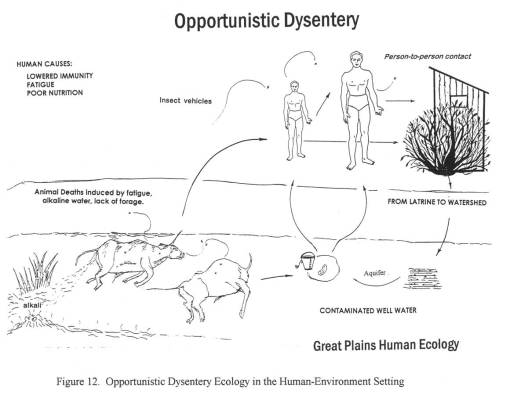
A possible source for contaminated foods causing diarrhea was uncovered for the fort in western Wyoming, just before the southwestward pass into Utah. This “Sioux trading post” as it was called provided travellers with food supplies, including self-produced dried meats. After that, a “Fort” run by an individual also provided a source for contaminated meats leading to diarrhea. A third location, a fort in Idaho, was unlikely to be the direct cause for the diarrhea that soon followed after passing by its walls; this fort had another problem related to the pile up of dead horse and oxen carcasses outside the fort itself, by a nearby water source.
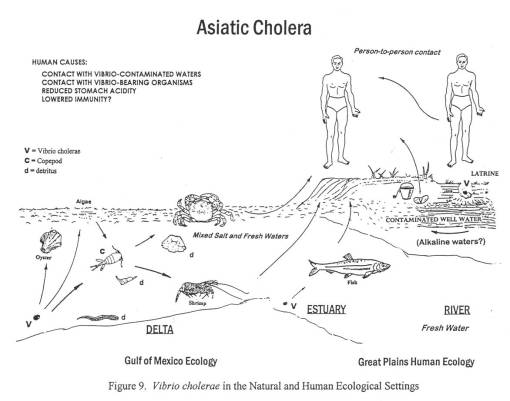
This project also required that I review the geography of another vector-borne trail disease–Rocky Mountain Spotted Fever (referred to by some as some form or Mountain fever linked to the Dysentery, the bloody diarrhea also experienced at that time). Typically transmitted by insecta infected by this organism through local deer populations, this disease has its own signs and symptoms, which for the most part lack any similarities with any of the diarheal epidemics reviewed. In short time, it was determined that this Mountain Fever was an incidental fever experienced by those also infected by Salmonella intermedia.

Also ruled out and researched for this study are the geography and epidemiological behaviors of Giardia, Listeria, Entamoeba (the cause for true dysentery) and even E. coli.
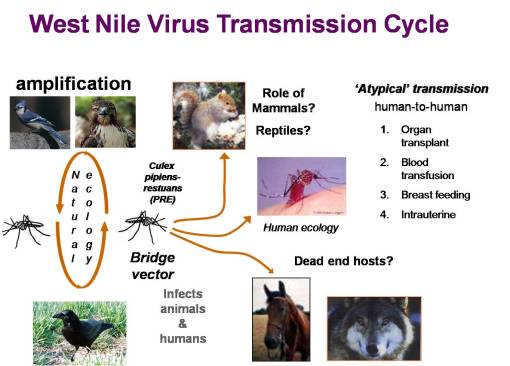
The Ecology of West Nile.

In 1999, the possibility of West Nile making its way to the US hit the news in the New York Times. This started me thinking about my experiences in the Hudson Valley as a child, the area where many of the dead crows associated with West Nile were being found. During my childhood in New York, I was very much a woodlands-bound boy, and knew all the streams, swamps, and glacial ice melt ponds in the county where I was raised. In 2000, I did some research on mosquito mapping, but focused mostly of two other public health matters popular for the time–cancer due to environmental causes and lyme disease due to tick-rodent ecology.

Both of these GIS epidemiology projects were supported by grants provided to me by several local agencies and one regional agency. The lyme disease research focused on the ecology of Lyme, Connecticut and the Hudson Valley where the disease managed to spread most rapidly, and the southern Oregon-northern California region where it was rapidly developing on the west coast. This work focused on host-vector ecology studies and resulted in my discovery of a natural border to lyme disease migration in southern Oregon–a chrysolithic soil region where the flora were non-supportive of the organism responsible for borellia disease, due to its host (rodents) behaviors and feeding needs and the impact of local flora and lizard populations on borrelia vitality (a local lizard has a natural defense against borrelia, and can carry it but prevent its passage to new hosts).

This told me that phytoecology/phytogeography played an important role in disease ecology, at an organismal level typically not-evaluated by disease ecologists. In 2002, when I made my way to New York, my first job in public health dealt with the local west nile fever problem now going at full pace. During my first season exploring this problem, I simply watched the disease and host-vector behaviors as they took place over the year. The following season, I inventoried all the data accumulated on the mosquito trapping that had been done since about 2000, and the various field observations made on mosquito larvae populations for the entire county. Once the data was tallied up, some temporal and location (ecologic) summaries could be proposed in relation to known causes for west nile and its particular mosquito species vectors to infect animals and people. In mid-2003, this enabled me to survey and develop detailed descriptions of all trapping and dead animal pick-up sites, leading to the development of a way to model mosquito behavior in relation to local land use, physiographic, topographic, phytogeographic, and hydrogeographic features. By July 2003, this enabled me to identify the first nidus or nest for positive testing west nile carriers in the county, through centroid analysis developed from the 3 positive testing crows just documented, species data pertaining to traps in the immediate region, and local ecologic studies.
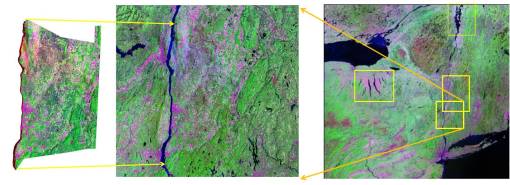
Throughout the remaining season, I developed and tested a way to perform transect studies of various types of regions to map out biodiversity and vector-related behaviors in relation to stream and flood plains geography, mountain edge elevation change, and phytoecology species richness and biodiversity features. I then added to this GIS work my experience with the use of National Landuse Classification Data (NLCD) digitized grid maps, Normalized Difference Vegetation Index (NDVI) raster maps, and aerial photographs. Small area analysis was performed around several sites with positive testing human cases and infected animal hosts. Mosquito species diversity in relation to species richness and biodiversity were statistically analyzed. Several major rivers/creeks were compared in terms of species distribution in relation to topography, landuse and human population density features. 60 miles of Hudson River shoreline was mapped for vector species to determine how species were distributed relative to river edge and whether or not the estuary itself had its own vector species ecology related to other brackish water west nile hosts noted in that state (paired shoreline and inland traps were set approximately every five miles or less). The GIS was used to document the source for a swarm of a nuisance species–a local sewage treatment center with sewage upwelling, release and a 20×50′ area of of notable ground-surface spillage.
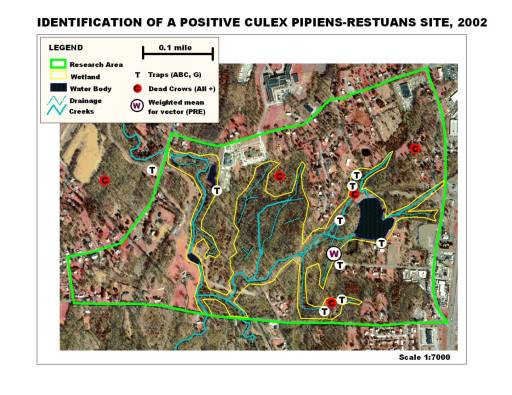
For Conference information and rewards received for this West Nile work see:

http://www.esri.com/library/newsletters/healthygis/healthygis-spring07.pdf

http://www.directionsmag.com/pressreleases/gis-users-excel-in-communication-service-and-vision-for-health-and-human-se/110759

http://www.gpsworld.com/gis/gis-and-mapping/news/esri-lauds-winners-2006-communication-service-and-vision-awards-7688

http://www.geoinformatics.com/blog/latest-news/esri-honors-award-winning-health-gis-programs-and-projects

http://www.gisdevelopment.net/news/viewn.asp?id=GIS:N_wkqbixdrmu&cat=New%20Products&sub=GIS