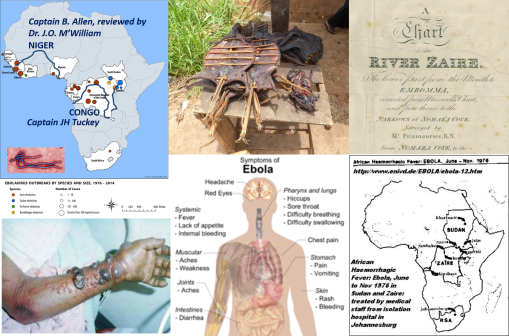
There are two important historical epidemics to note that are very similar to Ebola.  The first took place in 1816 along the Zaire/Conga River.  The second along the Niger River where it connects with Tschadda.  These are both epidemic that began with fever outbreaks, but which led to a high fatality rate and had symptoms that demonstrate a unique form of internal organs deterioration that other fever epidemics do not normally present with.  Fewer cases demonstrated the internal blood mass formations seen in the more contemporary outbreaks.  The most resemblance between these two outbreaks are their dates of initiation, days until fever symptoms, speed of spread to their others in the teams, and time until death.  Both were also colloquially termed “River Fever”  These support my premise that the Ebola and some  similar diseases have been around since they were first noted by the Portuguese missionaries in the 1690s.  Both of these overlap with the geographic distribution that we currently are familiar with, and are consistent with the topography, ecology and human population features determining how this disease may be spread.

Two months ago I posted two pages in sequence about the possibility that Ebola struck Africa much earlier than first noted in current journal articles.  This a re-posting of the first one of the two.  (Expect more on this epidemic history research at a later date.)

The very first map of diseases of the world depicts a condition with all the symptomatology, appearances and high degree of fatality the current Ebola outbreaks now present us with.  This map was produced by Friedrich Schnurrer, a professor in Oriental culture and history ( I review him extensively, with his biographies included, at https://brianaltonenmph.com/gis/historical-disease-maps/friedrich-schnurrers-charte-uber-die-geographische-ausbreitung-der-krankheiten-1827/ ).

Schnurrer’s map was dated 1827, and includes a description of a disease unique to the Congo, and no other parts of the world, described as “Gangran des Mastdarms nach heftigen Kopf u. lenden schmerzen Berriberri (Zuchelli)” (see also my own blog page with this–       https://brianaltonenmph.com/2014/10/14/is-there-an-early-history-for-ebola-preliminary-review-says-yes/ ).

An NIH article and complete book chapter devoted to this map also available for review at:    http://www.ncbi.nlm.nih.gov/pmc/articles/PMC2530995/  and  https://www.academia.edu/909628/The_first_global_map_of_the_distribution_of_human_diseases_Friedrich_Schnurrers_Charte_%C3%BCber_die_geographische_Ausbreitung_der_Krankheiten_1827_ 

One of the issues or concerns about reviewing historical medical writings on epidemics is whether or not the researcher is able to accurately identify the diseases writers refer to, especially prior to the 1860s.  This is when the differentiation of shared symptoms such fever, changes in skin color, and sweating were still questionable.  Physicians often described these symptoms in relation to just their fever cycles, and the place where the disease happened.  Topography and climate were just as important to identifying a disease as its exact symptomatology.  A ten or fifteen year difference in the references selected to make these identifications can easily result in misidentifications.

SchnurrersMapAfricaCloseupIncludedHighlighted

Still, we are very fortunate when it comes to trying to define “Gangren des mastdarms” on Schnurrer’s map.  Due to its uniquely deadly nature, and the symptoms it produced in its victims, Ebola can be differentiated from something as basic or simple as the various forms of malaria, yellow fever, and the flu.   Ebola was deadly, and caused symptoms such as a blackening of the skin prior to death, ulcerations, a rotting away of flesh.  Schnurrer’s map refers these symptoms for this disease (loose translation: Gangrene of the colon/rectum/lower intestine followed by heavy head & lumbar pain, beriberi), which occur only along the Congo River, that emaciating symptom, blistering with some resemblances to gangrene, the destruction of abdominal flesh, occurring over just a few days, leading to death.

Ebola versus Beri Beri vs. various sorts of Gangrene

Ebola versus Beri Beri versus various sorts of Gangrene

To confirm this suspicion, I uncovered two very convincing accounts of Ebola outbreaks that involved one missions program and a British military team making their way along the Congo river.  The earliest such epidemic occurred in the early colonial periods (see http://fr.wikipedia.org/wiki/Antonio_Zucchelli ), the second took place during the early 1800s as Africa was being explored much more deeply within its interior.

These two events, due to their symptoms and greater than 50% mortality, in very short time, and because of the descriptive information provided, are possibly early accounts of Ebola.  If they are not exactly the Ebola we know of today, they are certainly a relative or precursor of the more recent genotypes being expressed.  A common feature of the evolutionary theories of diseases  states that less dangerous forms of the disease erupted prior to the current much more deadly outbreaks.  When I defended my identification of the Oregon Trail “cholera” as not being Vibrio cholerae (V. comma).  [One CDC microbiologist and geneticist then present suggested it might even be one of the contemporary E. Coli strains with a choleratoxic like effect].

Ebola is a disease that is ecological in nature.   Chances are, it didn’t evolve recently in Africa, but instead presented itself several times before the 1960s.  Each time we make new attempts to inhabit and further settle some of the most heavily forested parts of Africa, we expose ourselves to new ecological settings where we can come in contact with previous strains of Ebolavirus that we haven’t yet become infected by.

*********************************************************

For additional citations related to the above, see

Zeitrechnungs-Tafeln für den historischen Handatlas: Mit steter Rücksicht …   By Friedrich Wilhelm Benicken . 1824.

http://books.google.com/books?id=P7lRAAAAcAAJ&pg=PA135 

“Deo Pater-Merolla Reife nach Congo. 1696. Der Missionar Ant. Zuchelli bereifet Congo. – Die Portugifen werden vom Kuatenhandel verbrängt, behalten jedoeh Mazagan und die vier Guinea-Infeln.”

and my other ScoopIt! posting on this:      http://www.scoop.it/t/an-episurveillance-researchers-guide/p/4029834704/2014/10/14/is-there-an-early-history-for-ebola-preliminary-review-says-yes 

See on Scoop.itEpisurveillance

When GIS was first promoted, it was very distinct from the similarly sounding technology term GPS.  Skillsets for each of these two were taught as two unique training sessions.  The GIS was slightly more adapted to research related work than GPS.  But GPS was more applicable and true in terms of its presentability.  These two technologies ultimately became somewhat dependent on each other.


The same was true for Remote Sensing and a host of other technologies that make use of distance to make their observations, over large areas of space, usually out of sight of whomever and whatever is being observed.  Google Map and other public mapping software made RS/Aerial photography commonplace information sources.


The geographic information systems (GIS) now being popularized, ranging from simple modeling programs without the spatial mathematical capabilities, to truly complex GIS becoming quite popular in many fields.   


Another form of spatial analytics made popular in the 1990s was grid analytics.  With grid analysis, you can perform many of the same calculations made using GIS, in much less time depending upon how you program your analytics system.     


Such is the case with NPHG.     


NPHG is a unique polygon/grid analytics technique I developed that carries out the basic spatial analyses provided by GIS, but with less than 1/100th the required systems time and manpower that doing the same with GIS.  


NPHG provides you the first insights into whatever topics you choose to researched.  These insights can be automated and can be produced on a daily or weekly basis; for thousands to tens of thousands of metrics per year using just one system.  This information can presented in "Atlas form", which in turn is useful for determining the next steps to take by applying a more traditional, time consuming, but visually impacting GIS analyses technique.    


NPHG can also be used to produce results in video form, which in turn can be reviewed in the field.  The resolution of these videos is unlimited; most are presented as national images.  But the image resolution can be modified to as small an area as you want.  A number of my earliest examples consisted of aerial fly-over surveillance tactics, with examples of zooming down on a region programmed in as well. 


The benefits of NPHG is that it functions without GIS and has minimal software requirements.  It can probably work in many data analysis and calculation work stations, but certain benefits from being on a more rapid, more effective parallel programming analytics setting such as Terabyte.    


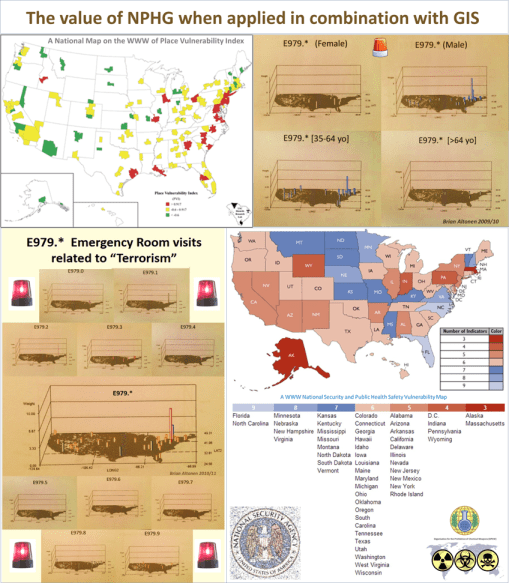
The figures here represent three styles for mapping the new public health problem, "bioterrorism."  All three were produced by separate research teams, two of them at about the same time in post-9-11 history (the first map, and E979.*).      


The upper left (first) map is a detailed review of risk areas in the U.S. based on various population density, sociological, economic, pop culture, and human ecological and behavioral study results.  The lower right map is a lightly later summary of these findings generated at the state level.   Both of these were developing using a traditional GIS, based on appearances, probably from two of the chief competitors.  


The base maps and results each of these require using merged, recoded, combined, reclassified and reanalyzed spatial data.   This process usually takes time to format and perfect the presentation for, not to mention the time to pull in the data and engage in whatever root analyses are necessary. 


The two E979 series map sets were produced using the NPHG algorithms, and took less than an hour to make all of maps, from scratch.  This mapped data was based on a review of data from about 0.5B EMR/EHR records for about 50M people.     The datapull  normally takes 5-15 minutes, the data crunch and mapping normally takes from 20 to 40 minutes.  75-100 separately analyses of E979 (total, by gender, by 4+ age groups, 10 E979 subgroups) can be completed in a day, producing just as many maps.    


The overlap noted for the findings in the sociological study and the NPHG EMR/EHR study is truly remarkable.     


NPHG may be used for rapid surveillance and detection of unexpected spatial changes.  Any mathematical formula may be written to detect these changes (increased border differences, increased claims or diagnosis per 24 hr/per week, increased cost, significant changes in diagnosis rates over time and space).  NPHG can be used for the surveillance process; the slower GIS processing technologies can be used to further break down those regions where new risks are found to exist.

See on Scoop.itNational Population Health Grid

One of the most controversial topics I have promoted the use of GIS for is the surveillance of natural resources, people, disease and the most significant threats to public health, food and water supplies, and our natural resources.  This is not a popular topic.  In most medical settings, even when a disease as deadly as the current Ebola shows its face, delving too deeply into more topics is too much for some.    


What Ebola points out to us, or reminds us about for those devoted to public health surveillance, is just how complex public health monitoring can be.  Rapid assessment tools (like NPHG) are imperative to developing the best surveillance programs.  


Still, to assist in surveillance, it helps to have insights into how other such events have happened.   


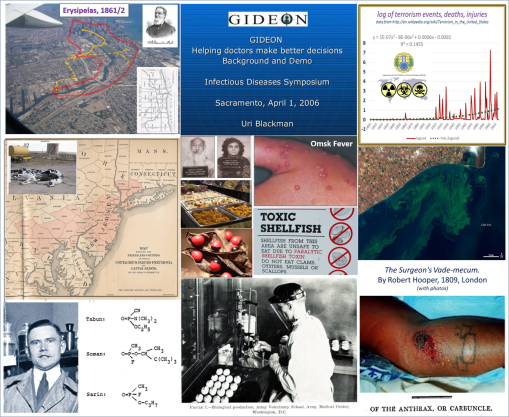
I produced this pinterest page, which is a collection of about 600 items that I developed and used to teach the past, present and future of terrorism/bioterrorism, epidemic outbreak patterns, disease diffusion patterns, and causative or related human behaviors.   I also used spatial research methods to describe and define many these past disease patterns.  One major advantage to this approach is that it helps me determine true causes for many of these events, even without direct microbiological evidence (i.e. my cholera thesis).      


The 600 collages, pictures, documents, news items, also enable us to compare past events with those of today.      


And they demonstrate why we need an effective spatial surveillance program.     


This site–  http://www.pinterest.com/altonenb/bioterrorism/ — reviews: past and current epidemics, disease patterns, spatial and ecological analyses of diseases, the history of terrorism, livestock disease diffusion, potentials for agriterrorism, foodways related emergent events, origins of the first chemical (biochemical) warfare in modern history, the contributions nations and industries have made to our programs, and what we should do to counter and defeat future events.  About half of this information has not been published in or reviewed by other sources.

See on Scoop.itMedical GIS Guide

You wouldn’t know it, but there is this social epidemic spreading throughout this country faster than the flu, STDs, or Ebola – – – it has to deal with childhood, adolesecent and teen suicides that occur due to bullying.

The news travels about bullying-linked suicides spread faster than any lessons we are learning right now about why these events happen.  And sometimes we tend to respond first, think later, producing news stories that result in more guttural responses than anything productive.

Sidetracked so much by the Ebola outbreak these past 6 months, another such event even in my own community led me to ask:  How many news stories have been posed in this past week about bullying at schools?  Are these stories more about the programs being developed to understand and manage bullying, or complaints about the system and how we are inadequately dealing with these bullying problems?

Well, there is a lot of evidence for the programs being developed right now.  But just as much evidence for the ongoing complaints that exist for the recurring deaths of younger and younger children.

In view of the most recent news development, a new form of anti-culturalism has even developed, leading to yet more bullying cases and more demonstrations of underlying racism within the school settings.  It ends up that social media is the main reason this behavior spreads.

Current counts in this new war seem to be 50:50 for either side.

Our typical reaction to a news story like this is to go all out trying to makes amends for this very social and culturally defined behavioral health problem repeated throughout this country.

But due to the events that just occurred, public frustration about about how to best deal with this public health problem is growing.

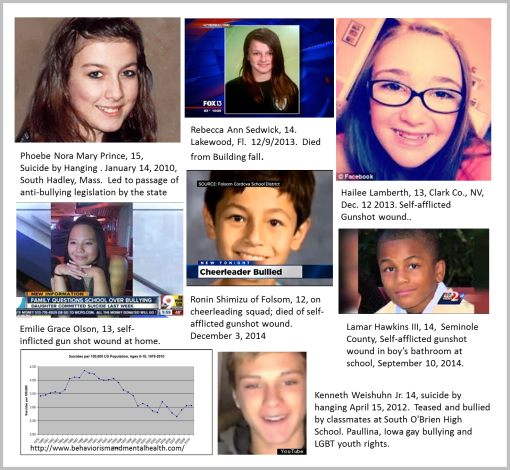
The following are examples the news posted about this problem in just the past month, followed by some links to the tales about the faces represented by the photos I assembled for this posting.

***********************************************

12/21/2014.  Minnesota.  Spring Lake Park school district revises bullying prohibition policy. By Sun Focus Editor, Olivia Alveshere.  http://focus.mnsun.com/2014/12/21/spring-lake-park-school-district-revises-bullying-prohibition-policy/ 

12/21/2014.  Students, parents seek bullying policies change.  by Ed Richter.  Ohio.  Fairfield Journal-news.  http://www.journal-news.com/news/news/students-parents-seek-bullying-policies-change/njXyP/   [life of Emilie Olsen]

12/21/2014.  Human Rights Commission to sue Brunswick schools over bullying.   Brunswick, Maine [VIDEO].  http://www.wcsh6.com/story/news/local/2014/12/19/brunswick-school-bullying-case-human-rights/20665619/ 

12/21/2014.  Glastonberry CT.  Glastonbury school combats bullying through song.

http://www.wfsb.com/story/27680186/glastonbury-school-combats-bullying-through-song 

12/20/2014. Utah.  Their Voice: Understanding the impact of bullying . by Monica Villar.  http://www.heraldextra.com/news/community/their-voice-understanding-the-impact-of-bullying/article_54d92552-e9d0-5bb7-bb46-e3e17254efd2.html 

12/19/2014.  NJ. North Hunterdon-Voorhees tops county in 2013-14 violence, bullying reports, says DOE.   By Christine Lee | Hunterdon County Democrat. http://www.nj.com/hunterdon-county-democrat/index.ssf/2014/12/north_hunterdon-voorhees_tops.html 

12/19/2014.  Pierce County, ND.  The Tribune.

Beyond the Classroom: Addressing bullying is complex for schools. Robert Bubach – Leeds Superintendent , Pierce County Tribune.  – See more at: http://www.thepiercecountytribune.com/page/content.detail/id/510337/Beyond-the-Classroom–Addressing-bullying-is-complex-for-schools.html?nav=5005#sthash.HiL9LBYx.dpuf 

12/18/2014.  Michigan.  The Detroit News.  Kolka: Parents and bullying.  by Kurt J. Kolka .  http://www.detroitnews.com/story/opinion/2014/12/18/kolka-parents-bullying/20555547/ 

12/18/2014.  Ocean City, MD.  Ocean City school board asked to do more about bullying.  by Claire Lowe.   http://www.shorenewstoday.com/snt/news/index.php/ocean-city-general-news/60474-ocean-city-school-board-asked-to-do-more-about-bullying.html 

“Maliha Mahbub Chowdhury. A name that will forever be engraved in the minds and heart of the people she loved. Maliha was a beautiful talented young lady who was so full of live. She had so many different talent. Drawing, dancing, singing, and bringing a smile to everyones face. Yet Maliah didnt notice the positive things about herself, and bullying in school which brought her self-esteem down she got tired and decided she woud give up [sic],”

12/18/2014.  Detroit.  Dearborn Heights teen charges anti-Arab bullying at school. Niraj Warikoo, Detroit Free Press .  http://www.freep.com/story/news/local/michigan/wayne/2014/12/18/arab-american-student-bullying-files-complaint/20615627/ 

12/18/2014. Students ‘Cross The Line’ To Stop Bullying In Schools. Eric Johnson, Move2Stand leader, engages eighth-graders with songs after a “Cross the Line” activity.  By Emily R. West.  The Greenville Sun, TN.   http://www.greenevillesun.com/xml/nitf/article_4a75095c-b450-5425-b3fe-134e80c35f39.html  

12/18/2014.  Lehigh Valley, NJ.  Express Times Staff.

How much violence, bullying was reported in your N.J. school?.   http://www.lehighvalleylive.com/newjersey/2014/12/how_much_violence_bullying_was.html   [Supports “declining” stats]

12/17/2014.  Our daughter killed herself because of racist bullies, claims devastated father. Darren Boyle.  DailyMail.com. Read more: http://www.dailymail.co.uk/news/article-2877278/Ohio-father-demands-know-racist-bullies-prompted-adopted-Chinese-daughter-life.html#ixzz3MY7PYN7a   [Emilie Grace Olson]
12/17/2014.  Las Vegas.  KNPRnews.

Las Vegas Schools Challenged By Cyber Bullying, Threats.  By CHRIS SIEROTY. http://knprnews.org/post/las-vegas-schools-challenged-cyber-bullying-threats [Preventive]

12/17/2014.  East Grand Forks.  Bullying: EGF Students Punched & Called Fat & Ugly.  by Neil Carlson.  http://www.valleynewslive.com/home/headlines/Bullying-EGF-Students-Punched–Called-Fat–Ugly–286127711.html 

12/16/2014.  Did racial bullying spur girl’s suicide? Dad thinks so
Michael D. Clark, mclark@enquirer.com.  http://www.cincinnati.com/story/news/education/2014/12/16/suicide-girl/20485201/ 

12/11/2014.  The Sacramento Bee.  Folsom Cordova schools chief calls for stronger bullying response following suicide. BY LORETTA KALB AND DARRELL SMITH    http://www.sacbee.com/news/local/education/article4435042.html#storylink=cpy

12/10/2014.  Metro Detroit schools face lawsuit claiming transgender child was bullied

Author: Hank Winchester,  http://www.clickondetroit.com/news/metro-detroit-schools-face-lawsuit-claiming-transgender-child-was-bullied/30120724 

12/10/2014.  Conestoga Public Schools promote anti-bullying policies . http://fremonttribune.com/cass-news/news/conestoga-public-schools-promote-anti-bullying-policies/article_f764198e-01d2-5aed-89ba-eec0c1ea2e86.html [Preventive]

12/9/2014.  Armonk, NY. Stacey Sager, WABC Eyewitness News (Ch7).   ‘BEAUTY BULLYING’ AT SCHOOL ON THE RISE DUE IN PART TO SOCIAL MEDIA.  http://7online.com/education/beauty-bullying-at-school-on-the-rise-in-age-of-social-media/428892/ 

12/9/2014.  Ohio.  Students play role in reducing bullying in Lorain County schools.  by Carol Harper.   http://www.morningjournal.com/general-news/20141209/students-play-role-in-reducing-bullying-in-lorain-county-schools  [Preventive]

12/5/2014.  California boy, 12, on cheerleading squad tragically took his life. By Amy Graff on December 5, 2014 12:43 PM.

http://blog.sfgate.com/sfmoms/2014/12/05/california-boy-12-on-cheerleading-squad-tragically-took-his-life/ 

12/4/2014. Escambia warns parents about new cyber bullying app New App targets Middle and Highschool Students.   http://www.pnj.com/story/news/education/2014/12/04/escambia-school-district-cyber-bullying-app/19892061/ 

12/4/2014.  New Mexico.  Schools seeing inroads on curbing bullying. By Thomas Garcia . http://www.cnjonline.com/2014/12/04/schools-seeing-inroads-on-curbing-bullying/ 

12/4/2014.  Massena, NY.  Watertown Daily Times.

Massena woman supports anti-bullying initiatives in Massena schools By BOB BECKSTEAD.   http://www.watertowndailytimes.com/article/20141204/NEWS05/141209327 

12/3/2014.  Myrtle beach.  8 Socastee High School students arrested in bullying incident. BY CLAIRE BYUN . http://www.myrtlebeachonline.com/2014/12/03/4646029/8-socastee-high-school-students.html#storylink=cpy 

12/3/2014.  After School Is The Latest Anonymous App Resulting In Student Cyberbullying And School Threats. [Yik Yak After School App].  Matt Burns.  http://techcrunch.com/2014/12/03/after-school-is-the-latest-anonymous-app-resulting-in-student-cyberbullying-and-school-threats/ 

12/3/2014.  Unique Anti-Bullying Program Making a Difference in Worthington Schools by Elizabeth Faugl.  http://abc6onyourside.com/news/features/top-stories/stories/Unique-Anti-Bullying-Program-Making-a-Difference-in-Worthington-Schools-61256.shtml#.VJbu-14CoM 

11/24/2014. (Included because it is from the Huff Post.)  Hundreds Of Students Protest Norman High School Over Alleged Bullying Of Rape Victims. The Huffington Post | By Rebecca Klein .  http://www.huffingtonpost.com/2014/11/24/norman-high-school-protest_n_6214222.html 

********************************************

More links for 2012-2014 VICTIMS (if not noted in above bibliography). — Fatalities brought on by Bullying.

4/17/12.  Kenneth Weishuhn, Gay Iowa Teen, Commits Suicide After Allegedly Receiving Death Threats. http://www.huffingtonpost.com/2012/04/17/kenneth-weishuhn-gay-iowa-teen-suicide_n_1431442.html 

9/13/2013.  Florida.  Rebecca Ann Sedwick Bullied For Months Before Suicide, Sheriff Says (VIDEO).   [12 yo]  Lakewood, FL.   http://www.huffingtonpost.com/2013/09/13/rebecca-ann-sedwick_n_3922738.html?utm_hp_ref=school-bullying 

12/12/2013.  Hailee Lamberth. (Dec. 12, 2013 suicide event.    http://www.reviewjournal.com/news/father-white-middle-school-student-s-suicide-related-bullying ; http://www.nydailynews.com/news/national/nev-school-didn-girl-parents-bullying-suicide-lawsuit-article-1.1984436 

Emily Grace Olson. http://www.dailymail.co.uk/news/article-2877278/Ohio-father-demands-know-racist-bullies-prompted-adopted-Chinese-daughter-life.html  

Lamar Hawkins.  Family: Boy who committed suicide was ‘repeatedly attacked’ by bullies. Lamar Hawkins III’s mother addresses media .  http://www.wesh.com/news/family-of-student-who-committed-suicide-at-greenwood-lakes-middle-school-to-address-bullying/28061180 ; http://www.nydailynews.com/news/national/bullies-won-son-killed-years-abuse-mom-article-1.1940725 ; http://newsone.com/3053647/lamar-hawkins-iii-florida-school-suicide/

*********************************************

HUFFINGTON POST SITE ON SCHOOL BULLYING

http://www.huffingtonpost.com/news/school-bullying/

*********************************************

BULLYING STATISTICS pages

http://www.stopbullying.gov/news/media/facts/ 

http://www.bullyingstatistics.org/content/bullying-and-suicide.html 

http://www.meganmeierfoundation.org/statistics.html 

CDC publication.

The Relationship Between Bullying and Suicide: What We Know and What it Means for Schools.

http://www.cdc.gov/violenceprevention/pdf/bullying-suicide-translation-final-a.pdf 

See on Scoop.itEpisurveillance

The government actually keeps track of this.

Source: www.vox.com

Turkey Farms are actually all around the Country.  A few years back I had the opportunity to photograph and evaluate a 200 year old farm that specialized in this poult industry, just before it was leveled for the building of new houses.     


With GMOs such a hot topic in the press, and a major topic of concern due to the unknown impacts of genetically engineered foodstuffs on the human body, this has become one of my most frequently visited sites . . . .         

“The James Way” of Raising Turkeys"   at     


https://brianaltonenmph.com/historical-buildings-and-sites/the-james-way-for-hens-and-turkeys/        


Turkey farms and public health have a shared history that is totally forgotten.  During the Sanitation Period in US history (lat 19th-early 20th C), turkey farms and many other livestock business settings were a major concern to epidemiologists.  Tuberculosis was a major concern, and the crowding of chicks led to large numbers of deaths at times.  This is when a major university in New York helped perfect the livestock veterinarian business, and produced a medicine that was administered to every new hatchling– Sulfaquinoxalamin.  Evidence for this was found as inspectors’ tags hung on  walls throughout the facility — these tags as "an aid in preventing outbreaks of coccidiosis due to Eimeria melengrimitis and E. adenoides.”     


What was once a religious based tradition in just a small secular part of  the colonies of North America had evolved into family business by 1900, and large businesses by the 1970s.  The continued evolution of this cultural practice into megaindustries has changed it from a single culture behavioral pattern into an omnicorporeal cultural system,  leading to the re-marketing of these teachings in the U.S. to further satisfy the needs for all cultures, be they Native American, Christian, Jewish, Muslim . . . ad libitum.       


At my personal blog site, I provide a unique perspective of the history of this industry and how it evolved from small private farms to large factory settings in the Dutch cultural settings of Hudson Valley, New York.  The interpretation of the Turkey farming industry takes a very unique sequent occupancy approach to demonstrate its impact on the various periods of US-American cultural and economic growth.       


This is one of my most common sites for elementary to high school teachers, especially this time of the year.

See on Scoop.itMedical GIS Guide

https://www.youtube.com/v/n5uECNUBRgw?fs=1&hl=fr_FR

http://youtu.be/n5uECNUBRgw BouttenouseFever 7 0803 0%

Source: www.youtube.com

I mapped some of the rarest diseases associated with in-migration of infected people, animals, hosts or vectors a number of years ago, soonafter successfully mapping the in-migration pattern of west nile and using this to employ GIS in identifying the location of a positive testing nidus based on a grouping of host and human cases within a 5 square mile area.


This collection of my 3D videos includes coverage of the following fairly rare forms of geozoonotic diagnoses:    


Bouttenouse Fever  – 0:22    |   

North Asian Tick Fever – Asia-Russia  –  0:21    |   

Queensland Tick Typhus –   0:23    |   

Creutzfeld Jacob, IP – 0:29     |   

Crimean or Congo Fever – Asia – Russia  –  0:41     |   

Guama Fever – 0:29     |   

Yakatopox-  0:28     |   

Omsk Fever – 0:27    |    

Guinea Worm -0:25    |   

Ratbite fever, ip – 0:36    |    

Foreign zoonotic diseases (aggregrated, depicting in-migration routes)               

See on Scoop.itNational Population Health Grid

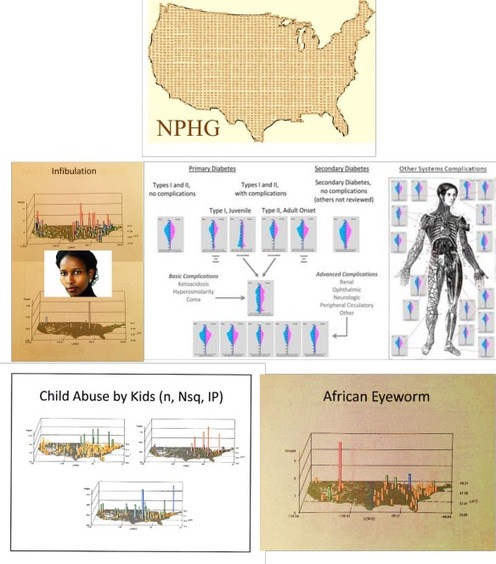
The woman in the poster board like collage is Ayaan Hirsi Ali.  She wrote a book detailing her infibulation experiences which helped to improve the social awareness about this controversial traditional African Muslim practice.  


Source: nationalpopulationhealthgrid.wordpress.com

This is one of several applications for GIS to medicine which I promote with regard to my NPHG approach to analyzing population health.  

Investigating sociocultural disease patterns is one of the most valuable uses for spatial epidemiology within the managed care setting.  It may also soon become the most controversial as we begin to point the finger at certain racial, ethnic or cultural causes for certain disease patterns.  

Four classes of "foreign diseases" are defined on this page.  

We are most familiar with just one or two of these classes, and spend little if any time investigating the remaining sociocultural issues in public health.

See on Scoop.itGlobal Health Care

165 health professionals from the country arrived in Sierra Leone on Thursday.


A related question to ask is


‘could Cuba in turn be impacted by the return of a physician who does not know he/she is infected?’


Source: www.washingtonpost.com

Cuba has an excellent healthcare system, and has taken steps that outshine many of the other country’s attempts to deal with Ebola.      


This has certainly been a feather in the cap so to speak.  But the next questions we all have to ask, the same that all other countries sending help need to ask as well, is how might this put ‘Us’ at risk back home?    


The point here is not to stop any international aid that is taking place due to Ebola.  The purpose of this posting is to more strongly state the criticisms out there about how borderline the success of preventing the international, intercontinental spread of Ebola has become.     


Cuba’s problem, were Ebola to enter the region, according to my opinion (based on studies, but still an opinion), is that Cuba has that additional factor to contend with regarding possible Ebola migration and penetration.  Cuba has some high risk community settings due to low income related living conditions.  The rural neighborhoods in particular that are low income have additional risk factors to consider, such as the natural climate and topography settings that helped Ebola travel its paths over the decades in Africa, through both southern and northern hemispheres.  But there are also the vegetation settings and animal spatial ecology patterns to consider.  The potential hosts, carriers and the like are there in the Cuban setting.  There is enough rural territory, with rolling terrain and highly varied microclimate settings, to make it possible for a parallel to the African tropical nidus to be discovered in a part of Cuba.  That is the heart of the matter in terms of Ebola and its potential for migration to Cuba.   


Cuba is an isolated region, like Iceland was for the various Measles epidemics that have been researched there over the decades.  One of the last things Cuba needs is for Ebola to reach its homeland.  


The Cuban economy and healthcare system are generous in what its people are are doing right now, participating in the Ebola epidemic response programs.  So, it is up to WHO and CDC to develop a more effective, prevention-minded program in order to prevent an accidental transportation of the disease to other places.      


The Cuban healthcare workers are no doubt more alert to this problem of possibly travelling with Ebola by accident than even the international and governmental groups seem to be.   But the repeated migration of isolated cases, from one area to the next for other countries (including the US), isn’t comforting when a disease highly epidemic due to its natural ecology becomes a  passenger finding its way to a new nidus or "hot spot".  The climate, topography, zoology, ecology and latitude and longitude for Cuba are right, making it possible for ebolavirus to become ecologically stable within this new setting.

See on Scoop.itEpisurveillance

http://docs.google.com/viewer?url=http%3A%2F%2Ftodayspractitioner.com%2Fwp-content%2Fuploads%2F2013%2F11%2FUnani-medicine-pt-1IMCJ113_Golabadi_24_30.pdf&embedded=true

Source: todayspractitioner.com

Since 1985, there has been an active attempt by just a few of us researchers to better understand Unani medicine.      

Unani medicine is now ready to expand the popularity of its practice in the United States (see links below), much like the practices of Caribbean African-American did about 20 years ago, in parts of the Southeastern and Southwestern United States (i.e. African herbalism, divining, spirituality, voodoo, hoodoo, etc.).      

Unani medicine has two cultural links–India and the Middle East (mostly Iran and Iraq).   

The social settings with the longest history of Unani practice are probably in the New York-New Jersey region, where they first developed storefronts and clinics devoted to this healing faith.   

There are a number of features of Unaniism that make it attractive to western medical patients.  Unaniism has a unique philosophy on personal, culture and mental health, attractive to some in much the same way that homeopathy, aromatherapy, shamanism, traditional chinese medicine and drumming have become popular culture complementary-alternative medicine (CAM) ways to treat certain patients.   

The following are additional sources on Unani practice:    


I focus extensively on Unaniism at my Pinterest page devoted to International Health at

 http://www.pinterest.com/altonenb/international-health/ 


and use it to demonstrate mixed research methods (combined qualitative/quantitative for PIPS and QIAs) at:

https://brianaltonenmph.com/biostatistics/grounded-theory/combined-qualitative-quantitative-methods/ 


Benchmarks for Training in Unani Medicine (WHO) — http://apps.who.int/medicinedocs/documents/s17558en/s17558en.pdf 


Links to Unani Medicine Sites — http://www.globinmed.com/index.php?option=com_content&view=article&id=99862:links-to-unani-system-of-medicine-and-related-websites&Itemid=186 


WHO and Unani growth and development — http://www.unani.com/who%20&%20unani.htm 

See on Scoop.itGlobal∑os® (GlobalEOS)

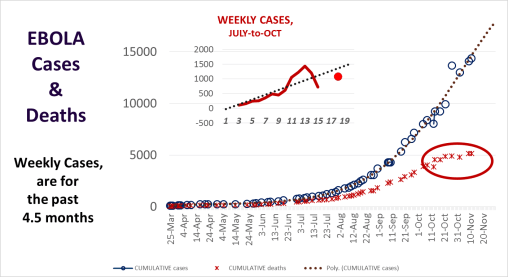
The rates of cases are certainly plateauing.  This CDC site — 2014 Ebola Outbreak in West Africa – Cumulative Reported Cases Graphs — has a review of the cases as they behaved in different countries over the past several months.

Source: www.cdc.gov

I posted a statement claiming that plateauing had commenced about a week ago, with the numbers evidence for my claim (although early, after just 2.5-3 weeks of leveled numbers in a row).  A number of months ago, my model stated this would happen in mid-October, which I correct the the end of October a month later as more weekly values could be evaluated.  My model suggests complete reductions due to a saturation of the population, resulting in an impact of the most susceptible followed by a loss in diffusion potentials.  This assumed there is no new population impacted, located in a very different part of the world like Europe or the United States.     


The model I use is a very basic deterministic model, which accounts for systems behavior, not innovative diffusion patterns like the more stochastic/probabilistic models like to depend upon.  Since Ebola is in its first pre-pandemic period, this is very much like the first years and diffusion of the earliest Cholera pandemic year–1832 about.  Models of that disease pattern published in the 1960s and 1970s demonstrated that a non-hierarchical behavior prevailed in the way the disease impacted the rest of the region infected.      


The second time through however in 1849/50 demonstrated a hierarchical diffusion pattern, in which the disease traveled great distances and impacted newer, uninfected populations far away from the source.   The future of these hierarchical diffusion processes are predetermined by certain human and natural ecological features, a product of the pathogen’s evolution and ecological history, in combination with climatic and seasonal weather patterns (in the extreme sense, El Nino and global warming impacts, latitude-linked isothermal lines, and the like).   Human migration helps the disease to spread, but its potential for become endemic to a region or naturalized is almost completely environmentally based, and heavily dependent upon zoonotic features (for both Cholera and Ebola).     


See Gerald F. Pyle’s Applied Medical Geography (Scripta Technica, 1979) for more detailed applications of this method for analyzing spatial disease patterns.    

See on Scoop.itMedical GIS Guide